Best Countertops for a Busy Family Kitchen
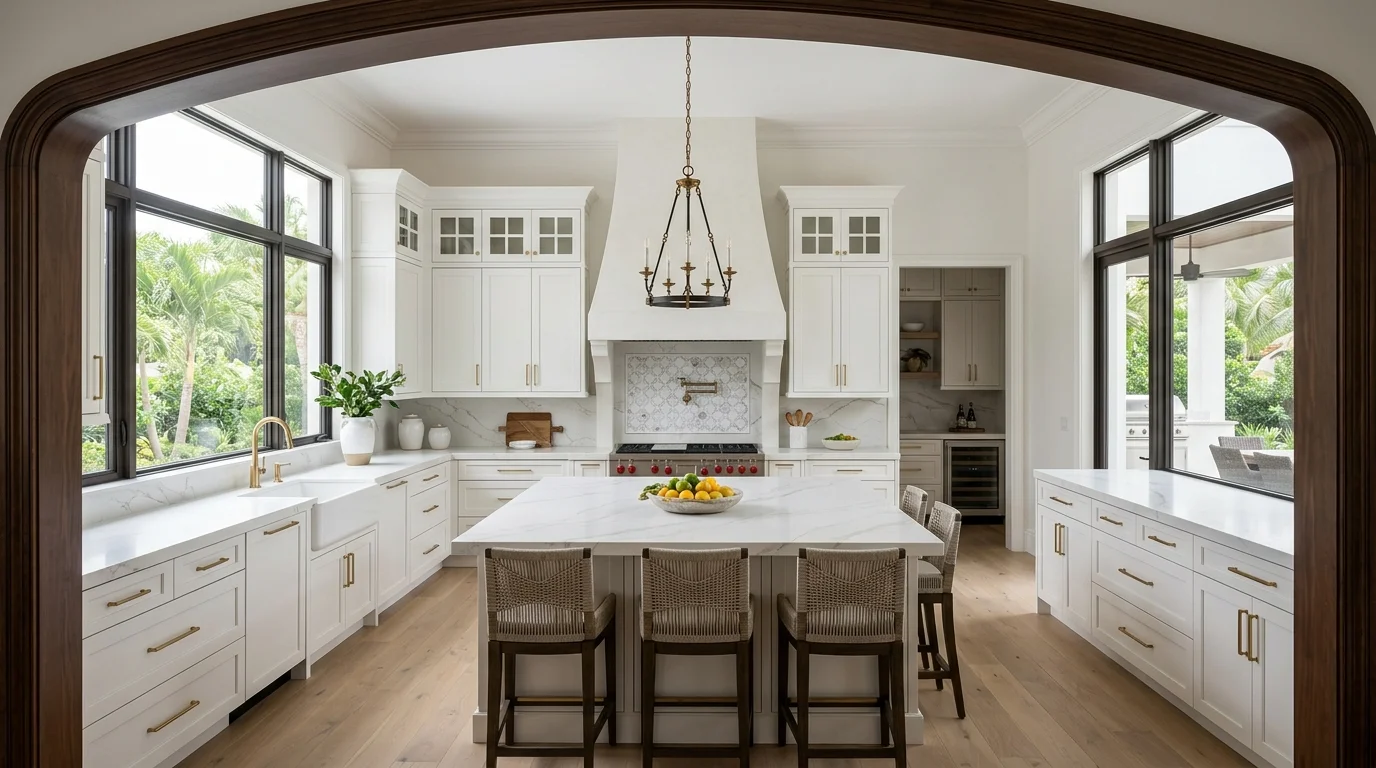
Choosing the best countertops for a family kitchen is one of those decisions that sounds simple until you have a seven-year-old dragging a Hot Wheels car across the surface and a teenager plopping a hot pan down without thinking twice. We work with busy families all across Palm Beach County every week, and countertop selection is almost always where the conversation gets real. The finish that looks great in a showroom can be a daily maintenance headache at home. This guide covers what actually holds up, what it costs in the Palm Beach County market, and what we recommend to our own clients in Boca Raton, Delray Beach, Wellington, and Jupiter.
Why Material Choice Matters More Than Color
Most homeowners start the countertop conversation with aesthetics. White, gray, veined, solid. That's fine. But in a family kitchen, aesthetics without durability is money thrown away. The real questions are: How does this surface handle spills left overnight? Can it take a cast iron pan set on it by accident? Does it scratch when someone cuts directly on it? Will it etch if a lemon half sits on it for twenty minutes?
Families with young kids or heavy cooks have a very different set of priorities than a retired couple with a showpiece kitchen. We design for how you actually live, not how you imagine you might live after the remodel.
Surface hardness, porosity, and heat resistance are the three technical specs that matter most for durability. Porosity determines staining risk. Hardness determines scratch resistance. Heat resistance determines whether a forgotten pan creates a permanent reminder. Once you understand those three factors, the right material becomes obvious for your household.
Color, edge profile, and finish can all be dialed in after you've picked the right material. If you're curious how edge choices affect both the look and the budget, our breakdown of countertop edge profiles in Palm Beach County is worth a read before you finalize anything.
The Top Three Materials for Family Kitchens
There are a lot of countertop materials out there. But when someone asks us what we'd put in our own family kitchen, the answer is almost always one of three: engineered quartz, quartzite, or porcelain slab. Here's why.
Engineered Quartz
Quartz is the workhorse of the family kitchen. It's made from ground natural quartz bound with resins and pigments, which makes it non-porous right out of the factory. That means no sealing, ever. Juice, coffee, wine, tomato sauce, none of it soaks in if you wipe it up within a reasonable amount of time. It won't etch from acids the way marble does. It's consistent in color and pattern across the full slab, so seams are easier to plan and less visually disruptive.
The scratch resistance is excellent, though not absolute. You can cut on it, but you'll dull your knives faster than the stone dulls. Use a cutting board anyway. The one real vulnerability of quartz is heat. The resins that make it non-porous can discolor or crack from sustained direct heat. Trivets are not optional. Beyond that, quartz is about as close to a set-it-and-forget-it material as you'll find.
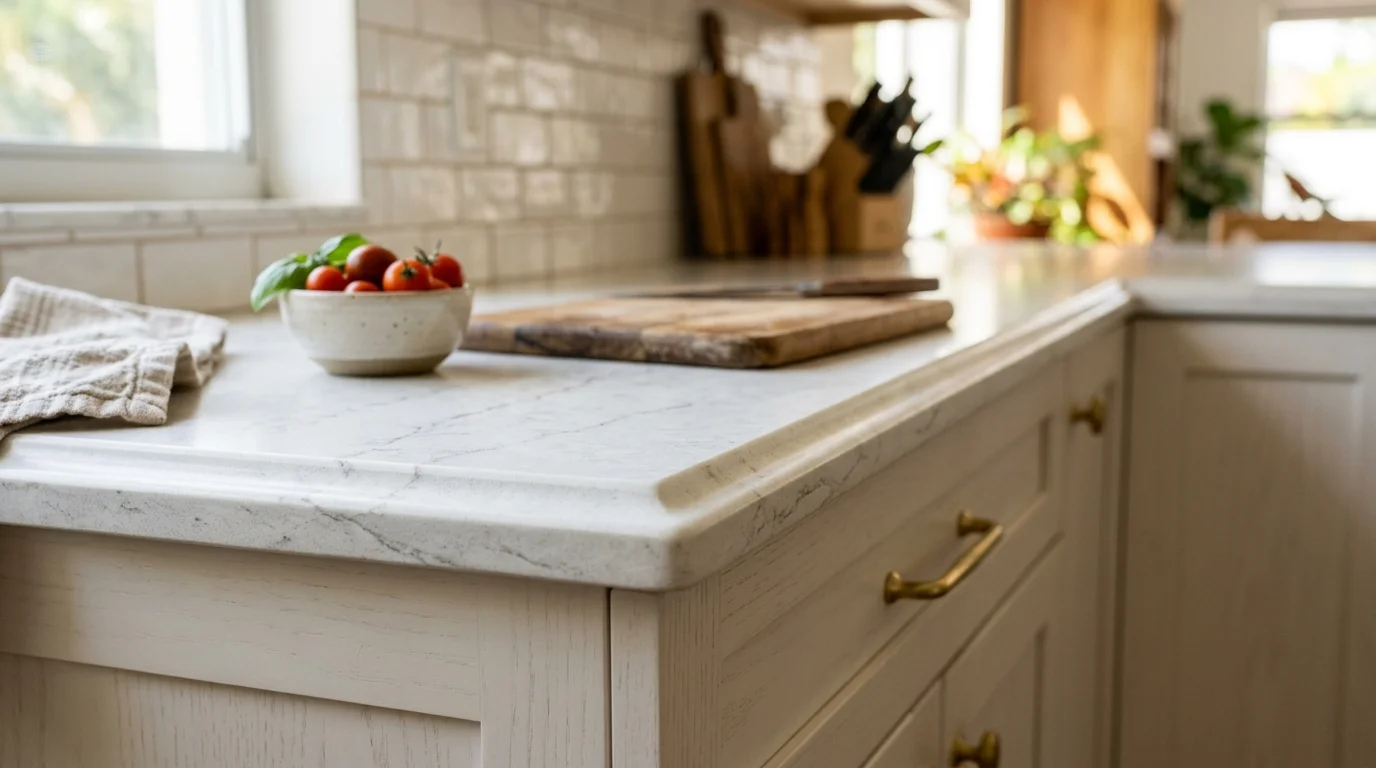
For families who want the look of marble without the anxiety of owning marble, Calacatta quartz hits that mark perfectly. The veining is engineered, so you get consistency without the porosity that makes real marble a maintenance commitment.
Quartzite
Quartzite is a natural stone, which immediately means it's not the same animal as engineered quartz. People confuse the two constantly. Quartzite forms when sandstone is metamorphosed under intense heat and pressure. The result is one of the hardest natural stones you can put in a kitchen. True quartzite, not marble or dolomite sold under a quartzite name, is harder than granite and significantly more scratch resistant than quartz.
The tradeoff is porosity. Natural quartzite needs to be sealed, and that sealing needs to be maintained. How often depends on the specific stone and how much abuse it takes. Some quartzites need annual sealing. Others hold up for several years between applications. Our article on whether quartzite needs to be sealed breaks down the specifics so you know what you're signing up for.
For families who want the uniqueness of a natural stone and are willing to commit to basic maintenance, quartzite is a spectacular choice. Taj Mahal and White Macaubas are consistently popular with our clients across Palm Beach County, and they age beautifully in the right setting.
Porcelain Slab
Porcelain slab countertops are the newest option on this list and probably the most underrated for family kitchens. Fired at extremely high temperatures, large-format porcelain slabs are essentially non-porous, UV stable, scratch resistant, and heat resistant to a degree that quartz simply can't match. You can set a hot pot directly on most porcelain surfaces without damage, which in a family kitchen is not a small thing.
The surface won't etch from acids, won't absorb stains, and requires zero sealing. The aesthetic range is enormous. You can get porcelain that convincingly mimics marble, concrete, wood grain, or solid color with a matte or polished finish.
The challenge with porcelain is fabrication. It's a harder, more brittle material to work with than quartz or natural stone, so it demands experienced fabricators. Not every shop handles it well. We have our preferred fabricators for porcelain work, and we're picky about it because the difference shows in the finished seams and cutouts. If you want the full picture on this material, our deep-dive on porcelain countertops covers everything from thickness to edge options.
Materials We'd Steer You Away From
We're not going to tell you every material outside our top three is wrong for every homeowner. But for a busy family kitchen specifically, a few materials create more headaches than they're worth.
Marble is the big one. Beautiful, yes. Practical for a family with kids and a real cooking habit? Rarely. Marble etches from acids, meaning citrus juice, wine, coffee, and even some cleaners leave permanent dull marks. It also stains. You can hone it to make the etching less noticeable, but you can't fully prevent it. If you're buying marble knowing all of that, and you're fine with it developing character over time, that's a personal choice. We'll install it. But we won't recommend it for a kitchen that sees daily chaos.
We have a thorough breakdown of the pros and cons of marble countertops for Florida kitchens if you want to go deeper on that conversation.
Granite is a better choice than marble for families, but it does require periodic sealing and can vary significantly in porosity depending on the specific stone. If you love a particular granite slab and it passes the water absorption test at the slab yard, it can work fine. Just go in knowing what the maintenance looks like.
Laminate is affordable and has improved significantly in recent years, but it's not in the same durability class as quartz, quartzite, or porcelain for a kitchen that takes daily punishment. It scratches, the edges can delaminate over time, and it can't be refinished. For a rental property or a flip, it makes sense. For a family home you're planning to stay in, spend a little more and get a surface that won't need replacing in eight years.
Cost Guide
Countertop costs in Palm Beach County vary based on material, slab quality, edge profile, and how complex your layout is. A peninsula with a waterfall edge costs more to fabricate than a straight run of countertop. The numbers below reflect our actual installed pricing in this market, including fabrication and installation. They don't include demo of your existing countertop, which typically adds $200-$600 depending on scope.
For a broader look at what countertop installation runs across different project types, our countertop installation cost guide for Palm Beach County breaks it down by scope and material.
These ranges assume a standard kitchen footprint of 40-70 square feet of countertop surface. Open layouts with large islands, butler's pantries, or complex sink cutouts push costs toward the top of each range. Island seating overhangs, which we always design for proper knee clearance, add some linear footage to the calculation. Our guide to countertop overhang for seating is worth reviewing before you finalize your island dimensions.
South Florida Considerations
The South Florida environment adds a few wrinkles that homeowners in other parts of the country don't have to think about. Humidity, UV exposure, and salt air are real factors here, especially in coastal communities from Jupiter down through Boca Raton.
Engineered quartz holds up well in humidity, but prolonged direct UV exposure can cause some colors to fade or yellow over time. This is most relevant for outdoor kitchens or kitchens with large unshaded glass facing south or west. For outdoor applications, porcelain slab or a UV-stable granite is a better choice than quartz. Our dedicated article on the best countertop materials for Florida humidity and heat goes into this in more detail.
For families in gated communities across Wellington or the western communities of Palm Beach County, HOA and ARB approvals can affect timelines. If your countertop replacement is part of a larger kitchen remodel that touches walls or changes the layout, your general contractor handles any required permit applications with the local building department. A straight countertop swap on existing cabinets typically doesn't require a permit, but if your project also involves relocating a sink or adding new electrical circuits, your GC will need to address those scopes before our crews arrive to install.
Salt air near the coast, in communities like Juno Beach or along the barrier islands, can accelerate corrosion on metal hardware but doesn't meaningfully affect quartz, quartzite, or porcelain surfaces. The countertop material itself is safe. What you do need to think about is your sink choice and faucet finish. Marine-grade stainless and PVD-finished fixtures hold up better than standard chrome in those environments.
One thing we see often in older Palm Beach County homes, particularly the 1980s and early 1990s builds that are so common in Boca Raton and Delray Beach, is that original cabinet boxes are often still structurally solid but the countertops are dated tile or worn laminate. A countertop upgrade without touching the cabinets can completely transform the feel of the kitchen at a fraction of a full remodel cost. That's a smart move if your cabinets are still in good shape. If you're on the fence about whether a full remodel or a targeted refresh makes more sense for your home, our comparison of kitchen refresh vs. full remodel lays out when each approach makes sense financially.
For families who are planning a larger project and want to understand the full budget picture, the NAHB remodeling research provides national benchmarks, though Palm Beach County pricing consistently runs 15-25% above national averages due to labor costs, material shipping, and local demand. Plan accordingly.
We also always recommend visiting a slab yard in person before making a final decision. Samples and digital photos don't do justice to how a full slab looks installed at scale. There are several reputable slab suppliers in Palm Beach County, and our guide to the best places to buy countertop slabs in Palm Beach County can help you figure out where to start.