How to Clean Quartzite Countertops Without Wrecking the Stone
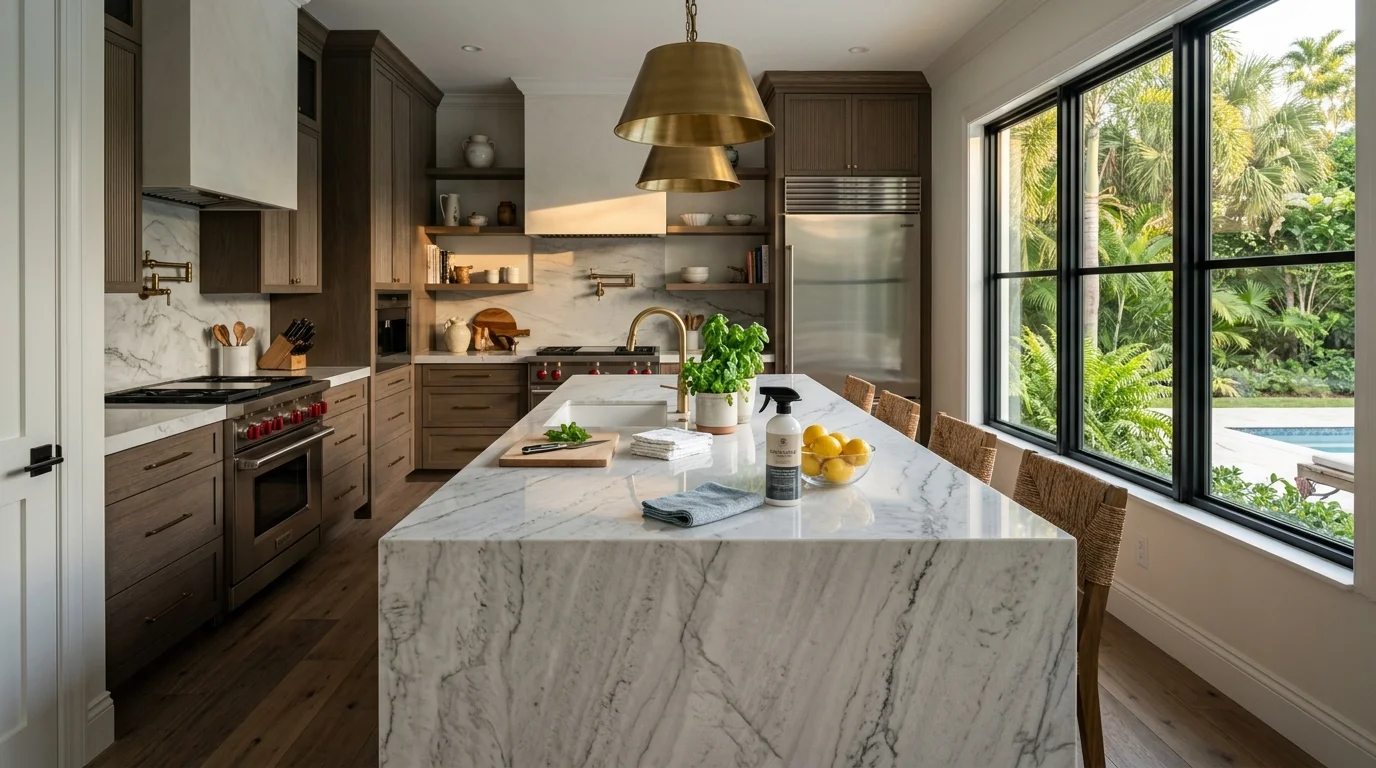
Knowing how to clean quartzite countertops correctly is the difference between a surface that looks stunning for decades and one that dulls, etches, or stains within a few years. Quartzite is a premium natural stone, genuinely hard, genuinely beautiful, but it is not indestructible, and it does not clean the same way quartz engineered stone does. We install quartzite in kitchens and bathrooms across Palm Beach County, Boca Raton, Delray Beach, Wellington, and Jupiter every month, and the number-one issue we see after installation is improper cleaning. This guide covers everything: daily habits, what to avoid, stain removal, and how sealing fits into the picture.
Why Quartzite Needs Different Care Than Quartz
This point causes more confusion than anything else in the stone world. Quartzite is a metamorphic rock formed from sandstone under extreme heat and pressure. It is a natural stone with a porous surface, mineral veining, and a hardness that typically falls between 7 and 7.5 on the Mohs scale. Quartz countertops, the Silestone, Cambria, MSI kind, are engineered surfaces made from ground quartz bound with resins. They are non-porous and largely maintenance-free.
Quartzite behaves much more like marble than quartz. It seals into its pores, it can etch from acidic exposure, and the wrong cleaner strips the sealer or damages the surface finish. If you have been cleaning your quartzite like you clean laminate or engineered quartz, that's likely where problems started. Our guide on Quartz vs. Quartzite countertops breaks down the material differences in depth if you want the full comparison before diving into care routines.
The other thing worth understanding: not every quartzite slab behaves identically. Taj Mahal quartzite, one of the most popular slabs we work with in Palm Beach County kitchens, is relatively dense and holds a seal well. More open-grained quartzites from certain Brazilian quarries are more porous and need more frequent sealing attention. Know your slab.
Daily Cleaning Routine
Keep daily cleaning simple. That is our consistent advice. Complicated routines get abandoned, and abandoned routines lead to buildup and damage.
Here is what works:
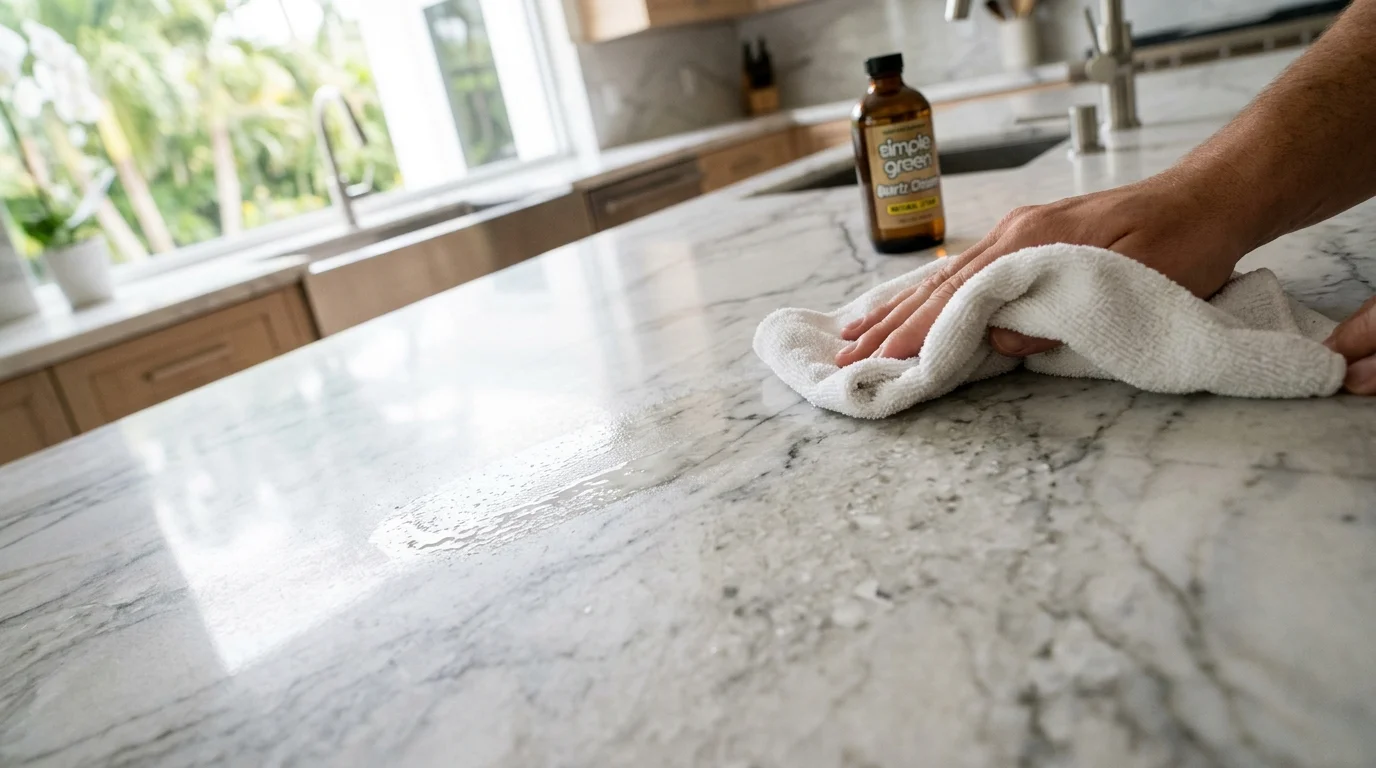
Warm water and a few drops of dish soap. A pH-neutral dish soap like Dawn diluted in warm water is your best daily driver. Wipe the surface with a soft microfiber cloth, rinse with clean water, and dry immediately. Do not let water pool on the surface, especially near the sink, because mineral deposits from South Florida's hard water will leave haze over time.
Dry after every wipe-down. This is non-negotiable in Florida. Our humidity means surfaces stay damp longer, and standing moisture penetrates the sealer faster here than it would in a drier climate. A quick pass with a dry microfiber takes ten seconds and protects years of stone.
Use a dedicated stone cleaner for deeper daily wipe-downs. Products like AKEMI stone care cleaners or Method Daily Granite Cleaner (which works well on quartzite too) are pH-balanced and sealer-safe. Spray, wipe, done. We recommend keeping one under the sink and making it as automatic as wiping crumbs off the counter.
Blot spills immediately. Do not wipe, blot. Wiping spreads the spill across more surface area and pushes it further into the stone. Press a cloth down, lift it, repeat. This matters most with oils, wine, coffee, and anything acidic.
What to avoid entirely on a daily basis: bleach-based sprays, ammonia cleaners (Windex is a common offender), vinegar, lemon juice, and anything marketed as a "multi-surface" or "bathroom" cleaner. Most of those are acidic or alkaline enough to break down the sealer and eventually etch the stone surface itself.
Avoiding Etching and Acid Damage
Etching is not a stain. A stain sits in the pores of the stone. An etch is actual surface damage, the acid chemically reacts with the calcium carbonate present in many quartzite slabs and leaves a dull, lighter mark that cannot be wiped away. You have to hone or polish the stone to fix a bad etch. That is a professional job.
Common acidic culprits in a South Florida kitchen:
- Citrus fruits, limes, lemons, oranges. We use them constantly here. One squeezed lime left sitting on an unsealed or under-sealed quartzite surface can etch in under a minute.
- Tomatoes and tomato-based sauces
- Vinegar, including vinegar-based salad dressings and cleaning sprays
- Wine, especially red
- Coffee and tea (mildly acidic, lower risk but cumulative)
- Some sparkling waters (carbonic acid)
- Cleaning products: bleach, ammonia, most bathroom sprays, and "natural" cleaners made with citric acid
The fix is not just to seal the stone, though sealing helps slow penetration and buys you time. The fix is behavioral. Use a cutting board. Do not prep citrus directly on the counter. Wipe spills immediately rather than letting them sit while you finish cooking. Put trivets under acidic sauces left simmering in pots. These habits cost nothing and keep the stone looking the way it did the day we installed it.
One more thing: heat. Quartzite handles heat better than quartz, but we still recommend trivets under hot pans. Thermal shock from a pan straight off a high-BTU gas burner can cause micro-fractures over time, particularly near sink cutouts and edges.
How to Remove Stains From Quartzite
Stains happen. Here is how to address the most common ones without causing more damage.
Oil-based stains (cooking oil, grease, butter): Make a poultice with baking soda and acetone or hydrogen peroxide. Mix to a peanut-butter consistency, apply over the stain, cover with plastic wrap taped at the edges, and leave it 24 hours. The poultice draws the oil out of the pores as it dries. Wipe clean, rinse, dry. Repeat if the stain is deep.
Organic stains (coffee, wine, juice, food dye): Use a poultice made with hydrogen peroxide (12% or higher) and a neutral absorbent like talc or flour. Same application method, paste, plastic wrap, 24 hours. For lighter organic stains on a well-sealed surface, a few drops of hydrogen peroxide left on the stain for five minutes before blotting will often do the job without a full poultice.
Water spots and mineral deposits: This is a chronic issue in Palm Beach County, Boca Raton, and Delray Beach where municipal water is on the harder side. Use a paste of baking soda and water, apply gently with a soft cloth in circular motions, rinse thoroughly, and dry. Do not use vinegar or CLR, both will etch. For stubborn mineral buildup, a stone-safe hard water remover like Bioclean Hard Water Stain Remover is a better call.
Ink or dye stains: Isopropyl alcohol on a cloth, applied directly to the stain, blotted repeatedly. Do not scrub.
Rust stains: These come from metal cans, certain fertilizers tracked in from the garage, or well water in some Wellington and Jupiter homes. Use a commercial stone rust remover, NOT a general rust remover like Rust-Oleum, which is far too acidic for natural stone. Iron Out Stone is a product formulated specifically for this. Apply per the manufacturer's directions.
One thing we want to be direct about: if a stain has been sitting for days or weeks, or if you can see actual etching (a dull, whitish mark that does not wipe away), call a stone restoration professional. No DIY product fixes a deep etch. A pro can hone the surface back to its original finish. Trying to sand or polish it yourself usually makes it worse.
For context, our approach to quartzite stain removal follows the same logic we apply in our guide on removing stains from marble countertopsnatural stone responds to poultice methods and pH-neutral chemistry, not the aggressive cleaners you'd use on synthetic surfaces.
Sealing Quartzite: What You Need to Know
Sealing is the single most important maintenance step for quartzite countertops, and it is also the most skipped. We have a full article covering whether quartzite needs to be sealed if you want the detailed breakdown, but here is the practical summary.
Yes, quartzite needs to be sealed. Most slabs need resealing once a year, though denser varieties like Taj Mahal may hold a professional penetrating sealer for 18-24 months in normal use. More porous quartzites may need sealing every six months in a high-use kitchen.
The test: drop a few tablespoons of water on the surface and let it sit for 15 minutes. If the water beads up, your sealer is intact. If it soaks in and leaves a dark spot, it is time to reseal. Run this test quarterly.
For sealer product recommendations, we steer clients toward penetrating (impregnating) sealers rather than topical coatings. Topical coatings sit on the surface and can peel, yellow, or go cloudy, a real problem in Florida's heat and UV exposure. Penetrating sealers soak into the pores and bond with the stone. Good options include Tenax Proseal, StoneTech BulletProof Sealer, and Miracle Sealants 511. All are available at stone supply houses in Palm Beach County or online.
Application process for a DIY reseal:
- Clean the surface thoroughly and let it dry completely, minimum four hours, overnight if possible.
- Apply the sealer in a thin, even coat with a lint-free cloth or foam applicator.
- Let it penetrate for the time specified on the product (usually 3-5 minutes).
- Buff off any excess before it dries on the surface, dried excess sealer hazes the stone.
- Apply a second coat if the first absorbed quickly.
- Avoid water contact on the surface for 24 hours after sealing.
If you are comparing quartzite's maintenance needs to granite, the process is very similar. Our granite countertop sealer guide covers penetrating sealer application in detail, and the technique translates directly to quartzite.
When we install quartzite countertops, the stone yard will have applied an initial seal before fabrication delivery. But that first factory seal is not a permanent solution, it is protection during transit and install. Your maintenance sealing schedule starts after installation is complete.
South Florida Considerations
Cleaning and maintaining quartzite in Palm Beach County, Boca Raton, Delray Beach, Wellington, or Jupiter is not identical to caring for the same countertop in Chicago or Denver. A few factors specific to our climate change the equation.
Hard water. South Florida municipal water is notoriously hard. Calcium and magnesium deposits build up faster here than almost anywhere in the country. That means mineral haze around the sink and near faucets is a constant battle. Dry your countertop edges after every dish-washing session. A water softener at the point of entry helps. Wiping down regularly with a dry microfiber is the simplest prevention.
Humidity and mold risk. Relative humidity in South Florida regularly runs above 70%, especially during summer. Moisture that gets under a poorly sealed quartzite countertop, particularly at the backsplash joint or around an undermount sink, can create conditions for mold growth in the substrate. Keep those joints caulked and inspect them annually. If caulk is cracking or pulling away, have it replaced. This is a Florida-specific maintenance item most national care guides do not mention.
UV exposure. Kitchens with large windows or open indoor-outdoor layouts, common in Jupiter and Wellington homes, see significant UV exposure on countertop surfaces. Some quartzites can shift slightly in color tone over years of direct sun. This does not affect structural integrity, but if you have a quartzite island near large south- or west-facing windows, consider UV-blocking window film. It protects the stone and the cabinetry finish.
Cooking habits. South Florida kitchens see a lot of citrus, vinegar-heavy marinades, and acidic tropical fruits. We are not going to tell you to change what you cook. Just keep a cutting board within arm's reach and make wiping spills immediately a reflex, not an afterthought.
If you are choosing between natural stone options for a new kitchen or bath, our guide on the best countertop materials for Florida's humidity gives you a full comparison with maintenance demands factored in. And if you are still deciding between quartzite and other premium stones, our quartz vs. quartzite vs. granite vs. marble comparison lays out every factor side by side.
One last thing: if your quartzite countertop is part of a larger kitchen that you are rethinking, whether it is a refresh or a full remodel, our team works with homeowners throughout Palm Beach County on both the design and installation side. Quartzite pairs exceptionally well with natural wood cabinetry and warm-toned finishes, which is a direction we are seeing a lot of in 2026 countertop design trends. If you are planning a project and want to talk through material selection, reach out to our team directly.