Cambria Countertops: Pros, Cons & Cost
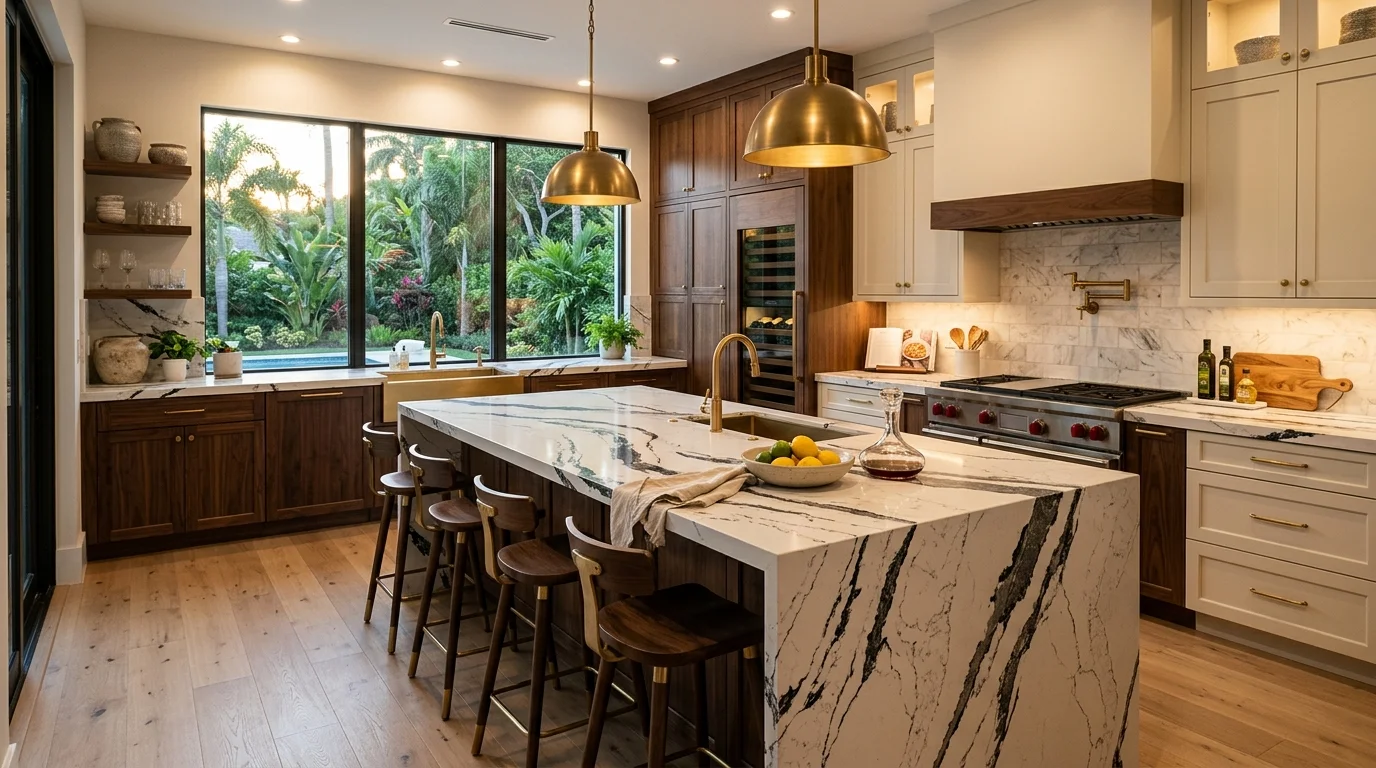
Cambria countertops come up in nearly every high-end kitchen consultation we do in Palm Beach County. Homeowners in Boca Raton, Jupiter, and Wellington have seen these slabs in showrooms and want to know whether the premium price is justified. Short answer: for the right homeowner, yes. For others, there are better fits. This guide breaks down exactly what Cambria is, what it costs in the South Florida market, which patterns work in our coastal light, and where the material falls short, so you can make a decision without the sales pitch.
What Is Cambria Quartz?
Cambria is an American-made engineered quartz brand, the only family-owned quartz manufacturer in the U.S., based out of Minnesota. Like all engineered quartz, the slabs are roughly 93% natural quartz aggregate bound with polymer resins. What sets Cambria apart from generic quartz is tighter quality control, a broader design library (over 200 patterns), and a full lifetime warranty that transfers with the home.
It's not quartzite. It's not marble. It's not granite. Engineered quartz is a manufactured product, which means every slab is consistent, no surprise veining shifts, no weak spots, no sealer required. If you want to understand how quartz stacks up against natural stone options, our breakdown of quartz vs quartzite vs granite vs marble covers the full comparison. Cambria simply sits at the top of the engineered quartz segment in terms of brand positioning and warranty coverage.
Cambria slabs are available in polished, matte, and textured (Cambria calls it "Honed" or "Luxe") finishes. Thicknesses run 2cm and 3cm, we almost always recommend 3cm for kitchen countertops in South Florida. It handles the heat and humidity better, and it doesn't need a plywood substrate for support the way 2cm does.
Pros of Cambria Countertops
There's a reason Cambria keeps showing up in Delray Beach and Jupiter kitchen remodels. The material earns its price in several genuine ways.
Non-porous surface. Cambria doesn't need sealing, ever. Granite needs resealing every one to three years. Quartzite may need it twice a year. Cambria's polymer-bound surface won't absorb bacteria, wine, coffee, or cooking oils. For South Florida households where kitchens get heavy daily use, that matters. If you're curious about how sealing works on other surfaces, see our guide on whether quartz countertops need to be sealed.
Full lifetime warranty. Cambria backs their product with a transferable lifetime warranty covering manufacturing defects. That transfers to the next buyer if you sell, a real selling point in the Palm Beach County real estate market where buyers notice warranties on expensive finishes.
Scratch and chip resistance. Cambria scores around 7 on the Mohs hardness scale, comparable to other quality quartz brands. You shouldn't cut directly on it, but it handles everyday contact better than marble and is far less prone to chipping at edges than granite. We have a full post on cutting on quartz countertops if that's a concern.
American manufacturing. Cambria controls their own production in Le Sueur, Minnesota. That means more consistent quality from slab to slab than brands that source from multiple overseas suppliers. For large kitchens requiring multiple slabs, common in the bigger homes we work on in Wellington and Boca Raton, that consistency matters for pattern matching.
Heat resistance (within reason). Cambria handles brief contact with warm pots better than some polymer-heavy quartz brands. That said, we still recommend trivets. The resins in any engineered quartz can discolor under sustained high heat.
Design range. Over 200 patterns means there's something for coastal kitchens, Mediterranean-inspired spaces, modern minimalist layouts, and everything in between. The marble-look patterns have gotten genuinely good, close enough to fool most guests.
Cons of Cambria Countertops
Cambria isn't perfect for everyone. Here's where the material has real limitations.
Price. Cambria costs more than most quartz brands. In Palm Beach County, installed Cambria runs $85-$140 per square foot, compared to $55-$95 for mid-tier quartz like Silestone or MSI. If budget is tight, that gap matters. You can get a very good quartz countertop for less, and for some homeowners, that's the right call. See our full quartz countertop cost guide for Palm Beach County to understand the full range.
Not great for outdoor applications. Cambria recommends against using their product outdoors in direct UV exposure. The resins can fade or discolor over time. If you're building an outdoor kitchen in South Florida, which we see constantly, look at porcelain or dekton instead. Our guide on outdoor kitchen countertops best for Florida covers the right materials for that scope.
Heat limits still apply. Unlike dekton or porcelain, Cambria isn't fully heat-proof. Hot pans left directly on the surface can cause thermal shock and discoloration. It's a minor inconvenience for most cooks, but worth knowing upfront.
Can look artificial up close. The marble-look patterns have improved dramatically, but if you put a Cambria slab next to real Calacatta marble or Taj Mahal quartzite, you'll see the difference. Natural stone has depth and variation that manufactured surfaces can't fully replicate. If authenticity of material is important to you, that conversation is worth having.
Limited availability locally. Not every countertop fabricator in Palm Beach County stocks Cambria or has trained installers. You'll want to work with a shop that has an active Cambria account and experience with their slabs, otherwise you risk poor seam work or edge inconsistencies.
Popular Cambria Patterns for South Florida Kitchens
With 200-plus options, picking a pattern is genuinely the hardest part. Here's what we see working well in South Florida homes.
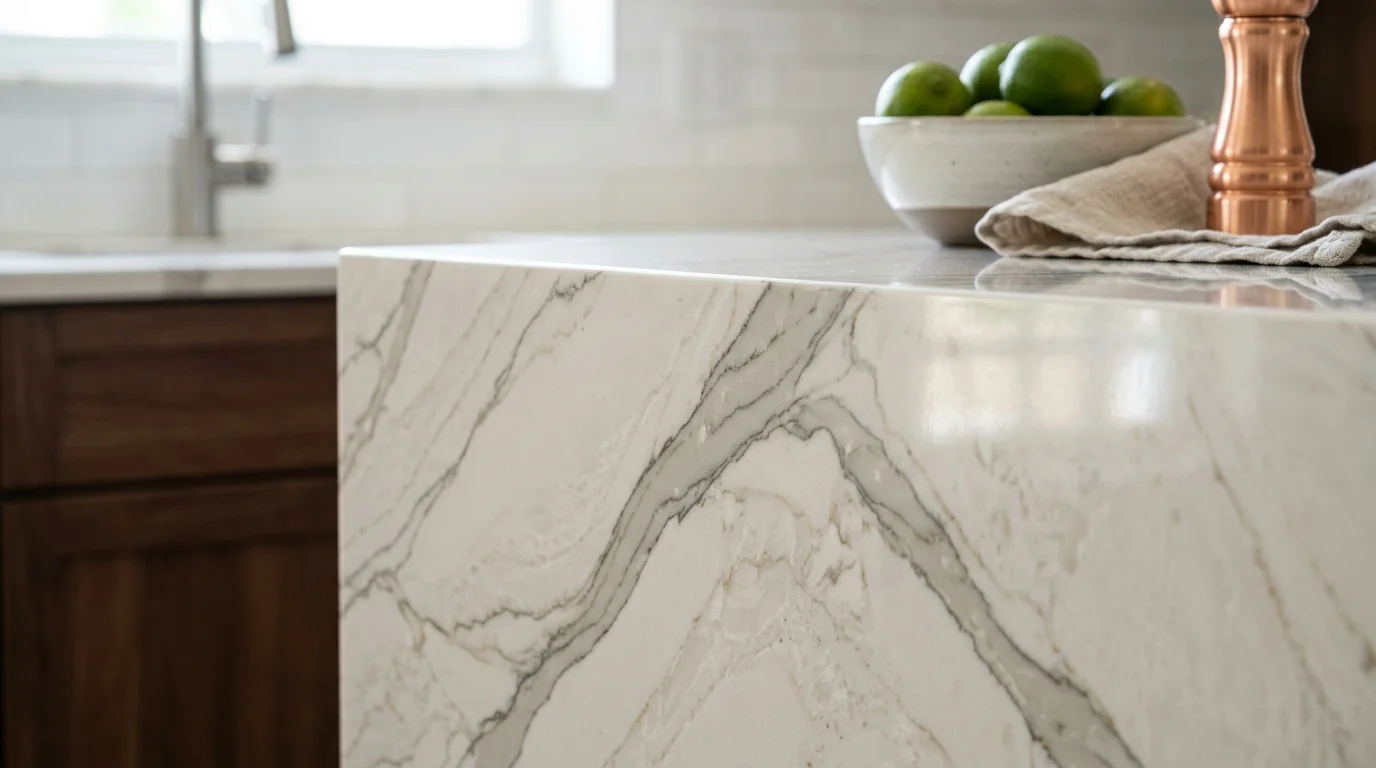
Brittanicca and Brittanicca Warm. The most popular Cambria pattern we see requested. White background with soft gray veining, it reads as Carrara marble without the maintenance. Brittanicca Warm adds a cream undertone that pairs beautifully with natural wood cabinet tones. Both work well in the bright coastal light you get in Boca Raton and Jupiter homes.
Portrush. Dramatic white-and-gray movement with bold veining. Works well in larger kitchens where the countertop becomes a focal point. We've installed it against dark navy and deep sage cabinetry with excellent results.
Ironsbridge. A warm beige-and-taupe palette with organic movement. For homeowners who want something other than white-and-gray, this is a strong option. Pairs well with wood tones and warm hardware finishes.
Skara Brae. Concrete-look pattern in soft gray tones. Popular in modern and transitional kitchens, especially in condo remodels in Delray Beach where a cleaner, urban aesthetic fits the space.
Galloway. Soft white with subtle movement, understated for homeowners who want the quartz durability but don't want a busy countertop. Works in just about any kitchen style.
For homeowners designing an all-white kitchen, Brittanicca or Galloway tend to be our first recommendations. If you want to see how white countertops play with different cabinet and backsplash combinations, take a look at our post on white quartz countertops and the best kitchen looks.
Edge profiles also change how a slab reads. Cambria's thicker 3cm material takes a waterfall, mitered, or eased profile well. For a full rundown of edge options, see our countertop edge profiles guide for Palm Beach County.
Cambria Countertop Cost in Palm Beach County
Here's what homeowners in Palm Beach County, Boca Raton, Delray Beach, Wellington, and Jupiter are paying for Cambria countertops in 2025-2026. These are installed prices, material plus fabrication plus installation. They do not include demo of existing countertops, plumbing reconnection (your GC handles that), or backsplash work.
How does Cambria compare to the competition? Mid-tier quartz brands (Silestone, MSI Q Premium, Allen + Roth) installed in Palm Beach County typically run $55-$95 per square foot all-in, so Cambria's premium is real, usually $15-$30 per square foot over comparable alternatives. Against natural stone, Cambria is often less expensive than premium quartzite like Taj Mahal or Van Gogh, and significantly less maintenance-intensive. Against marble, Cambria wins on durability and cost over time, even if the upfront price is similar.
One thing to watch: slab waste. Cambria's dramatic patterns require careful layout to match veining across seams, which can increase material waste by 15-25% on complex kitchens. Your fabricator should account for this in the quote. If you're reading a quote and something looks off, our guide on how to read a contractor quote walks through what to look for.
South Florida Considerations
Palm Beach County's climate and home styles create a few specific things to think through when choosing Cambria.
Humidity and heat don't affect Cambria directly. Unlike wood countertops, which can warp and crack in our humidity, or marble, which absorbs moisture, Cambria's non-porous surface is indifferent to South Florida's weather. That's a genuine advantage here. We work in a lot of coastal homes in Jupiter and Boca Raton where salt air and kitchen steam are constant factors, Cambria holds up without issue.
Light matters for pattern selection. South Florida homes get a lot of natural light, which means bright, high-contrast patterns like Portrush can feel overwhelming in a smaller kitchen. We usually suggest bringing a large sample home and looking at it at different times of day before committing. The white-based patterns like Brittanicca tend to be more forgiving in our light conditions.
HOA and condo board approvals. If you're in a gated community or condo building in Delray Beach or Boca Raton, your HOA may require approval for interior finish changes. That process is typically handled by your general contractor, we supply the specifications and design details needed for the package. Worth checking your HOA docs before you order material.
Outdoor kitchens: Cambria is the wrong call. We see a lot of South Florida homeowners wanting to extend their interior countertop material to their outdoor kitchen for a cohesive look. Cambria explicitly doesn't warrant outdoor applications, and the UV exposure and temperature swings in our climate will eventually damage the resin binders. Use porcelain or dekton outdoors.
Resale value. The Palm Beach County real estate market responds well to quality countertop materials. Cambria's transferable warranty is a genuine talking point at resale, buyers at the $600K, $1.5M price point notice it. If you're remodeling with an eye toward selling, Cambria is a defensible upgrade, especially in kitchens where the countertop is a focal point. Our guide on which kitchen upgrades add the most value in Florida puts countertop upgrades in broader context.
Pairing with local cabinet styles. In South Florida, we see Cambria paired most often with white shaker cabinets, natural wood cabinets, and two-tone designs. The brand's white-and-gray patterns do a lot of heavy lifting in bright, coastal interiors. For ideas on how different countertop materials interact with color and design trends, our countertop design trends for 2026 is worth a look before finalizing your selection.
Bottom line from our team: Cambria is a premium product that earns its price for homeowners who want low maintenance, a strong warranty, and a design library that competes with natural stone. It's not the right call if budget is tight or if the application is outdoors. For the right kitchen in the right home, and we see a lot of those across Palm Beach County, Cambria is hard to argue against.