Marble-Look Quartzite: Taj Mahal & More
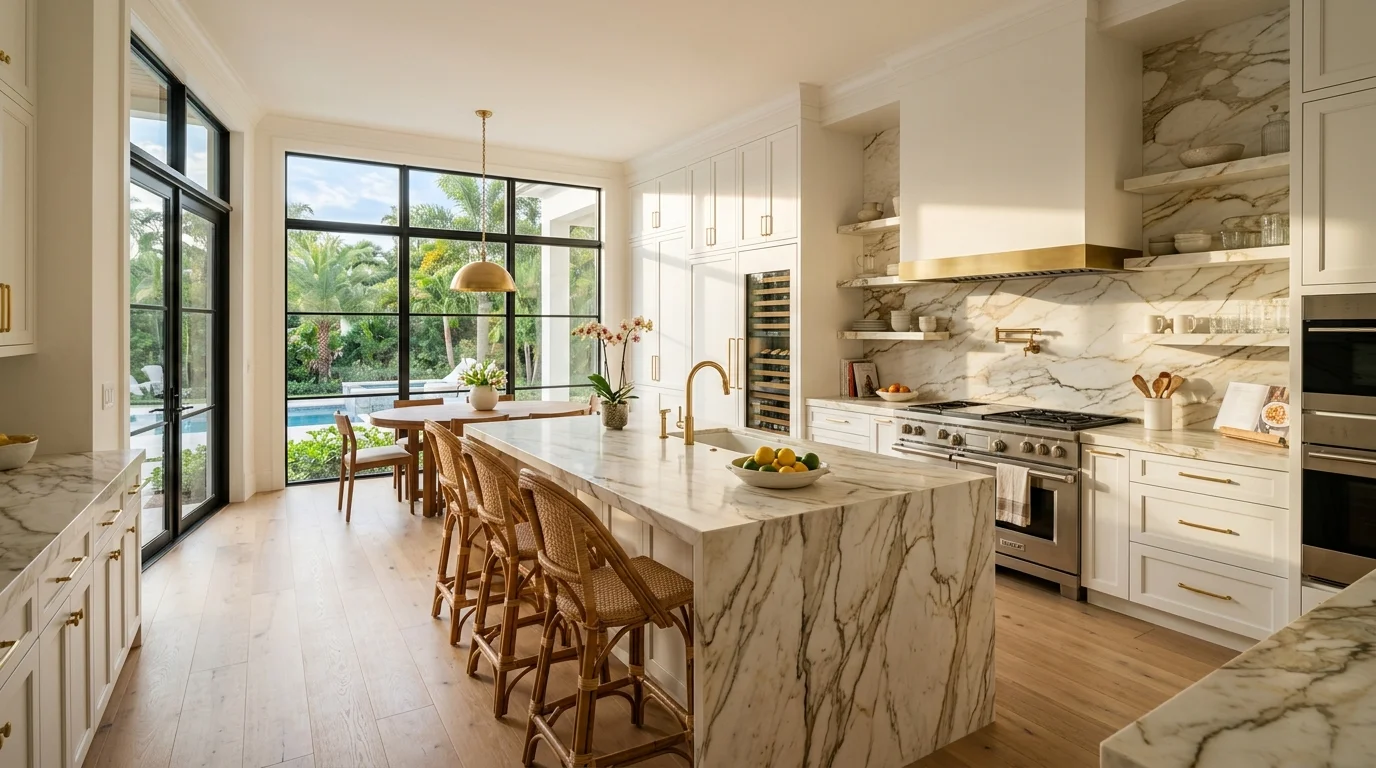
If you want the look of marble but you cook, entertain, or just live hard on your countertops, marble look quartzite is the material worth talking about. Slabs like Taj Mahal, White Macaubas, and Calacatta Gold quartzite deliver soft cream backgrounds, flowing veins, and that high-end stone feel, without the acid sensitivity that makes true marble a maintenance challenge in active kitchens. At South Florida Kitchen & Bath Design, we work with these stones regularly across Palm Beach County, Boca Raton, Delray Beach, Wellington, and Jupiter, and homeowners are consistently blown away by how refined the finished product looks.
What Is Marble-Look Quartzite?
Quartzite is a metamorphic rock formed when sandstone is subjected to intense heat and pressure deep in the earth. That process fuses the sand grains into a dense, crystalline structure that is significantly harder than marble. Some quartzite slabs carry veining patterns strikingly similar to Calacatta or Statuario marble, which is why they have become the go-to stone for homeowners who want that classic white-and-gold or white-and-gray look without the trade-offs.
The confusion in the market is real, though. Some stone yards label soft quartzite, dolomite, or even marble itself as "quartzite" to make it sound more durable. This is a known problem in the natural stone industry. Hardness testing, specifically the Mohs scale, is the most reliable field check. True quartzite scores between 7 and 8 on the Mohs scale. Marble sits around 3 to 4. If a slab that looks like quartzite scratches easily with a steel knife or fizzes when a drop of vinegar touches it, it is probably not true quartzite. Ask your stone yard for the hardness rating before you commit.
For a broader comparison of how quartzite stacks up against quartz, granite, and marble, our guide on quartz vs quartzite vs granite vs marble breaks it all down in practical terms.
Popular Marble-Look Quartzite Slabs
Not all marble-look quartzites are the same material, same hardness, or same maintenance level. Here is an honest look at the most popular options our team sources for Palm Beach County projects.
Taj Mahal is the most requested marble-look quartzite we see right now, and for good reason. It has a warm cream-to-ivory background with soft gold and caramel veining. It pairs beautifully with white cabinets, natural wood tones, and brushed brass or unlacquered brass hardware. Taj Mahal is a true quartzite, meaning it is dense and resistant to scratching. It still needs sealing, but it holds up far better than marble under daily kitchen use. We have a full resource on Taj Mahal quartzite for Palm Beach County kitchens if you want to go deep on this specific slab.
White Macaubas is another true quartzite with a cooler, white-to-silver background and linear veining that mimics Carrara marble. It is one of the most marble-like quartzites on the market, and it tends to be slightly less expensive than Taj Mahal. Our crews have used it on kitchen islands in Jupiter and Boca Raton projects where the homeowner wanted a bright, crisp look.
Calacatta Gold Quartzite (not to be confused with Calacatta Gold marble or quartz) has a white background with bold gold and gray veining. It reads more dramatic than Taj Mahal and works well as a statement island. Be careful here: slabs sold under this name vary widely in hardness. Always verify you are getting true quartzite, not dolomite or soft marble.
Sea Pearl is a quartzite with a pearlescent gray-green-white movement that photographs beautifully but reads a bit more organic in person. It works well in coastal kitchens and spa-style bathrooms. It is a popular choice in Delray Beach and coastal Wellington homes where the natural material palette is already in play.
Azul Macaubas breaks from the white-and-cream family entirely. It has a blue-gray background with dramatic white veining. It is a true quartzite, exceptionally hard, and polarizing in the best way. It works as a statement piece: a powder room vanity top, a kitchen island waterfall, or a feature bathroom wall.
Patagonia is technically a quartzite with warm tan, terracotta, and cream tones that read very different from the classic white marble look. It is worth mentioning because it is sometimes marketed alongside the marble-look quartzites even though it has an entirely different aesthetic. Some of our clients in Mediterranean-style homes in Boca Raton love it for exactly that reason.
For sealing guidance that applies across all of these slabs, see our resource on whether quartzite needs to be sealed so you understand the maintenance commitment before purchasing.
Quartzite vs Real Marble: Durability Compared
This is the comparison that matters most for homeowners who love the look but are worried about maintenance. Here is where they actually differ.
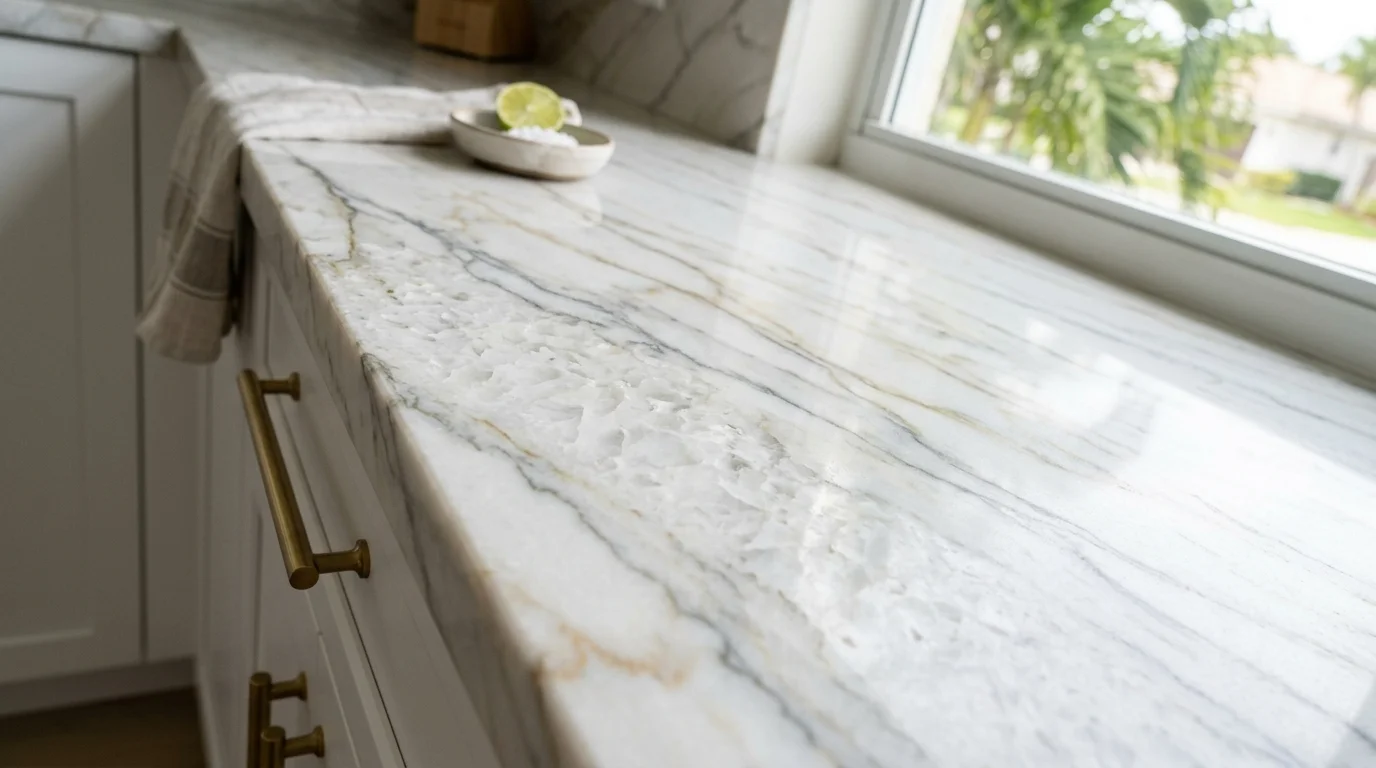
Marble is calcium carbonate. That means acids, including lemon juice, vinegar, wine, and even sparkling water, will etch the surface. Etching is not a stain you can wipe away. It is a chemical reaction that dulls the polish permanently. You can re-hone or re-polish marble to remove etching, but that costs money and time. In an active South Florida kitchen where someone is squeezing citrus over the counter, marble takes a beating. It also scratches more easily than quartzite because of its lower hardness rating.
True quartzite does not etch. Acids do not react with the silica-based stone the same way they do with calcium carbonate. You can set a lemon half down on Taj Mahal or White Macaubas and wipe it up without damage. That is a meaningful practical difference for a kitchen counter that gets daily use.
That said, quartzite is not maintenance-free. It is porous and needs sealing, typically once a year depending on use and the specific slab's porosity. It can chip at the edges under impact, just like any natural stone. And because it is harder, it is more challenging to fabricate, which is one reason it costs more than marble in most cases.
If you are seriously considering real marble and want to understand the full picture before deciding, our breakdown of marble countertop pros and cons for Florida kitchens is worth reading alongside this article. For families with kids who are hard on surfaces, we almost always steer people toward quartzite over marble. The look is nearly identical in many slabs. The forgiveness is not.
One more note: some homeowners ask about quartz (engineered stone) as an alternative to both. Quartz is non-porous and does not need sealing. It will not etch. But it cannot handle prolonged direct sun exposure without potential color shifts, which matters in South Florida homes with large windows and outdoor transitions. Quartzite handles UV exposure without issue since it is natural stone. For a side-by-side look at the two, our quartz vs quartzite countertops guide covers the key differences homeowners often miss.
The Natural Stone Institute publishes care and maintenance standards for quartzite and other natural stones, which is a useful reference if you want to go beyond the basics on sealing and long-term upkeep.
Cost Guide
Marble-look quartzite costs more than most quartz products and most granite. The premium comes from two places: the raw material cost and the fabrication difficulty. Quartzite is harder than marble and most granite, which means blades wear faster and cutting takes more time. Expect to pay for that. The prices below reflect Palm Beach County market rates from our experience, including material and fabrication but not installation labor separately (most fabricators bundle cut-and-install).
Slab selection matters as much as the stone type. Two slabs of Taj Mahal from different quarries can look very different. We always recommend homeowners visit the stone yard in person to select their specific slab rather than approving a sample. What you see on a 4-inch chip is not what you see across 20 linear feet of countertop. For guidance on where to look, our article on the best places to buy countertop slabs in Palm Beach County covers the local options worth visiting.
Edge profiles also affect cost. A simple eased or straight edge adds little to the price. A mitered waterfall edge or a book-matched panel will add significantly. See our countertop edge profiles guide for Palm Beach County for a full breakdown of what each profile adds to the budget.
South Florida Considerations
Quartzite is one of the better natural stone choices for South Florida specifically. Here is why that matters in our climate and housing context.
The humidity here is relentless. Porous stones that are improperly sealed can develop mold growth in the substrate over time, particularly on bathroom vanities and around sinks. Quartzite is porous but less so than many marbles, and when sealed correctly and regularly, it performs well in humid conditions. The sealing schedule is not optional, though. It is part of owning this material. Mark it on your calendar and treat it as maintenance, not an upgrade.
UV exposure is a real factor in South Florida homes with large windows, glass doors, or open transitions to outdoor kitchens. Quartzite, as a natural stone, is UV-stable. The color you see in the slab is the color you will see in 10 years. That is a genuine advantage over some engineered surfaces that can yellow or shift under prolonged sun exposure.
Outdoor use is another conversation. Quartzite can work for covered outdoor kitchens in terms of heat and UV resistance. However, standing water and freeze-thaw cycles (not relevant in South Florida) are the bigger concerns for outdoor stone. In our market, the primary outdoor concern is whether the finish will hold up against rain splashing back onto a countertop edge. A honed or leathered finish tends to be more forgiving outdoors than a high-polish surface that shows water spots readily. Our resource on outdoor kitchen countertops in Florida gets into which materials hold up best in South Florida conditions.
From a home value perspective, marble-look quartzite reads as a luxury finish to buyers in Palm Beach County, Boca Raton, and Wellington. It is a material that shows well in listing photos and holds up in buyer walkthroughs in a way that engineered quartz sometimes does not. If you are remodeling with resale in mind, quartzite is a defensible investment. If you want to understand the broader ROI picture on kitchen upgrades in this market, our piece on which kitchen upgrades add the most value in Florida puts countertops in context alongside cabinets, appliances, and layout changes.
One common question from homeowners in Boca Raton and Jupiter is about condo association rules. If your building has an HOA or ARB review process, natural stone selections sometimes need to be submitted as part of a materials package. Your general contractor handles the permit and HOA submission process. Our team supplies the design drawings and material specifications that go into that package. For a realistic look at what kitchen remodels cost across Palm Beach County before you budget your countertop spend, our kitchen remodel cost guide for Palm Beach County is the right place to start.