Warm Minimalism Kitchens: Wood Tones, Clean Lines and Calm That Lasts
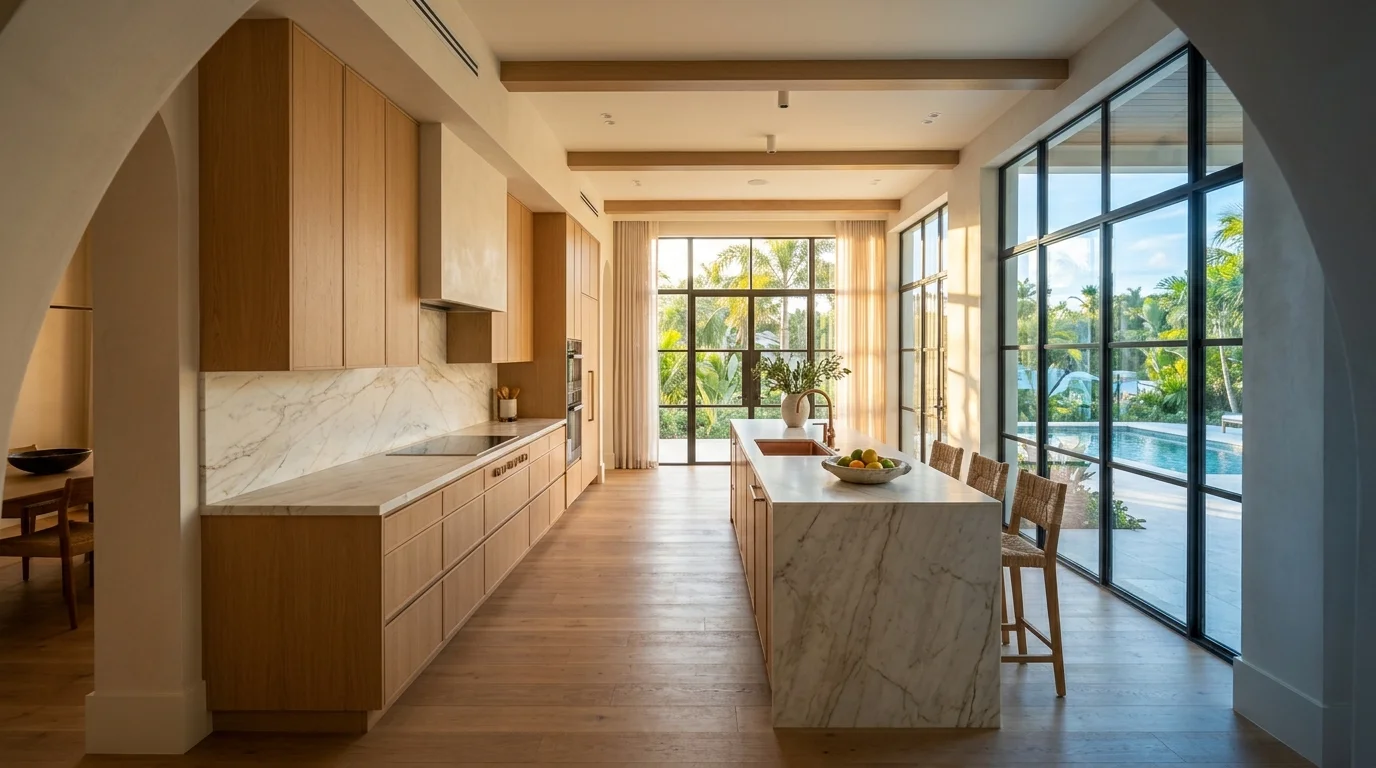
The warm minimalist kitchen is the design direction we hear about most from homeowners across Palm Beach County right now, and for good reason. It rejects the cold, everything-white aesthetic that dominated a decade ago and replaces it with something that actually feels like a home. Natural wood tones, flat or slim-profile cabinet doors, stone surfaces with organic movement, and a deliberately restrained palette. That is the warm minimalist kitchen at its core. It is not sparse. It is intentional. And in South Florida's sunlight, it looks extraordinary.
What Warm Minimalism Actually Means
Minimalism on its own can feel clinical. Stark white cabinets, polished surfaces, no visual warmth anywhere. That version works in some contexts, but most families do not want to cook in a laboratory. Warm minimalism fixes that by layering in natural materials while keeping the lines clean and the clutter absent.
The defining characteristics are straightforward. Cabinet doors are flat-front or slim shaker with almost no ornamentation. Colors lean toward warm neutrals: linen, greige, soft taupe, muted sage, or bare wood tones. Countertops feature stone with quiet veining rather than dramatic patterns. Hardware is minimal but warm, often brushed brass or matte black. Open shelving, when it appears at all, is used sparingly. No upper cabinet clutter. No busy backsplash competing with everything else.
What makes it work in South Florida specifically is the light. Boca Raton, Delray Beach, Wellington, Jupiter, the natural light here is intense and directional. Warm wood tones glow in that light. Cold grays and pure whites can read harsh. We have watched homeowners choose warm minimalist kitchens after seeing how their all-white kitchen looked at noon in August, and it is a consistent turning point.
This aesthetic also pairs naturally with the open-plan layouts common in Palm Beach County homes built since the 1990s. The kitchen is on display from the living room, the dining area, and sometimes the lanai. A warm, calm kitchen anchors those spaces. If you are comparing this direction to other popular looks right now, our 2026 kitchen color trends guide shows how warm neutrals and wood tones are pulling ahead of cooler palettes across the board.
Cabinets and Wood Tones That Define the Look
The cabinets carry this look. Get them right, and everything else falls into place. Get them wrong, and no amount of expensive stone will save it.
The two cabinet directions we recommend most for warm minimalist kitchens are rift-cut white oak and flat-front painted cabinetry in a warm neutral. Those are not the only options, but they deliver the best results consistently.
Rift-cut white oak gives you tight, linear grain without the pronounced cathedral pattern of plain-sawn wood. It reads refined rather than rustic. It photographs beautifully and ages gracefully in Florida's humidity, especially when finished with a matte or satin lacquer rather than a heavy gloss. We have been specifying rift-cut white oak regularly, and Fabuwood's natural oak cabinet line has made this grain profile accessible at a price point that fits mid-range budgets. Our breakdown of Fabuwood's rift-cut white oak cabinets goes into the specifics if you want to see what that product looks like in real applications.
Flat-front doors are the other pillar of this aesthetic. No rails, no raised panels, no decorative profiles. Just a clean slab door in a warm tone. We prefer flat-front over traditional shaker here because the shaker's inner profile adds visual noise that interrupts the calm you are trying to create. That said, a slim shaker with a very narrow inner frame can work if you want a touch more dimension. We covered the full comparison in our flat-front vs. shaker cabinets guide if you want to work through that decision.
Color on painted cabinets should stay in the warm neutral zone. Linen whites, greige, warm taupes, and soft greens with yellow or brown undertones all work. Avoid anything with a blue or gray undertone, it will shift cool the moment South Florida sun hits it. If you are drawn to green, the muted sage and olive directions we see in Jupiter and North Palm Beach homes tend to hold beautifully in natural light. Cold greens do not.
Two-tone approaches work well in this aesthetic, too. A warm wood tone on the island paired with painted uppers in linen is one of the most popular combinations we design. The island grounds the room, the painted uppers keep it light. It never looks dated because neither element is trendy on its own.
Floor-to-ceiling cabinetry is a strong move in warm minimalist kitchens. It eliminates the gap above the cabinets where dust accumulates, removes visual clutter, and lets the wood or paint finish run uninterrupted from floor to ceiling. Floor-to-ceiling cabinet design also maximizes storage, which matters when you are pulling upper cabinet clutter off the counters to maintain that clean look.
Countertops and Backsplash Choices
In a warm minimalist kitchen, the countertop is a surface, not a statement. That does not mean boring. It means the stone works with the cabinets rather than competing with them.
Our first recommendation is quartzite or quartz in a warm white or soft beige with minimal, organic veining. Taj Mahal quartzite is the gold standard here. It has a creamy warm white background with soft gold and taupe movement that picks up wood tones beautifully. It is a natural stone, so it requires sealing, but the visual payoff is real. We have installed it in Wellington and Palm Beach Gardens homes where the natural stone bridges the wood cabinets and the lighter walls without any jarring transitions.
If natural stone feels like too much maintenance, a warm white quartz with subtle veining gets you 80% of the way there. Avoid bright white quartz with heavy gray veining, it pulls the palette cold. We also like honed finishes over polished in this aesthetic. Honed quartzite and honed quartz read softer, more tactile, and more in keeping with the overall warmth of the design. Our guide on honed vs. polished countertops walks through the maintenance differences so you know what you are getting into before you commit.
Leathered granite is another option worth considering. The texture is subtle but adds tactile interest without visual noise. In warm tones, think cream, beige, or warm gray granite, a leathered finish feels right at home in this aesthetic.
The backsplash is where most people over-complicate warm minimalist kitchens. The temptation is to add pattern or color here, but restraint is what makes this look work. Our strongest recommendation: run the countertop material up as a slab backsplash. Same stone, continuous run from counter to upper cabinets. No grout lines, no competing pattern, nothing to interrupt the calm. It is the most popular backsplash choice among the warm minimalist kitchens we design right now, and the results are consistently striking. Alternatively, a large-format tile in a warm neutral with minimal grout lines achieves a similar effect at a lower price point. What we steer away from: busy zellige, heavily patterned mosaic, and high-contrast subway tile. Those belong in other aesthetics.
Hardware, Lighting, and the Details That Tie It Together
The details in a warm minimalist kitchen are not afterthoughts. They are the difference between a kitchen that looks pulled-together and one that looks like a magazine page that never quite materialized in real life.
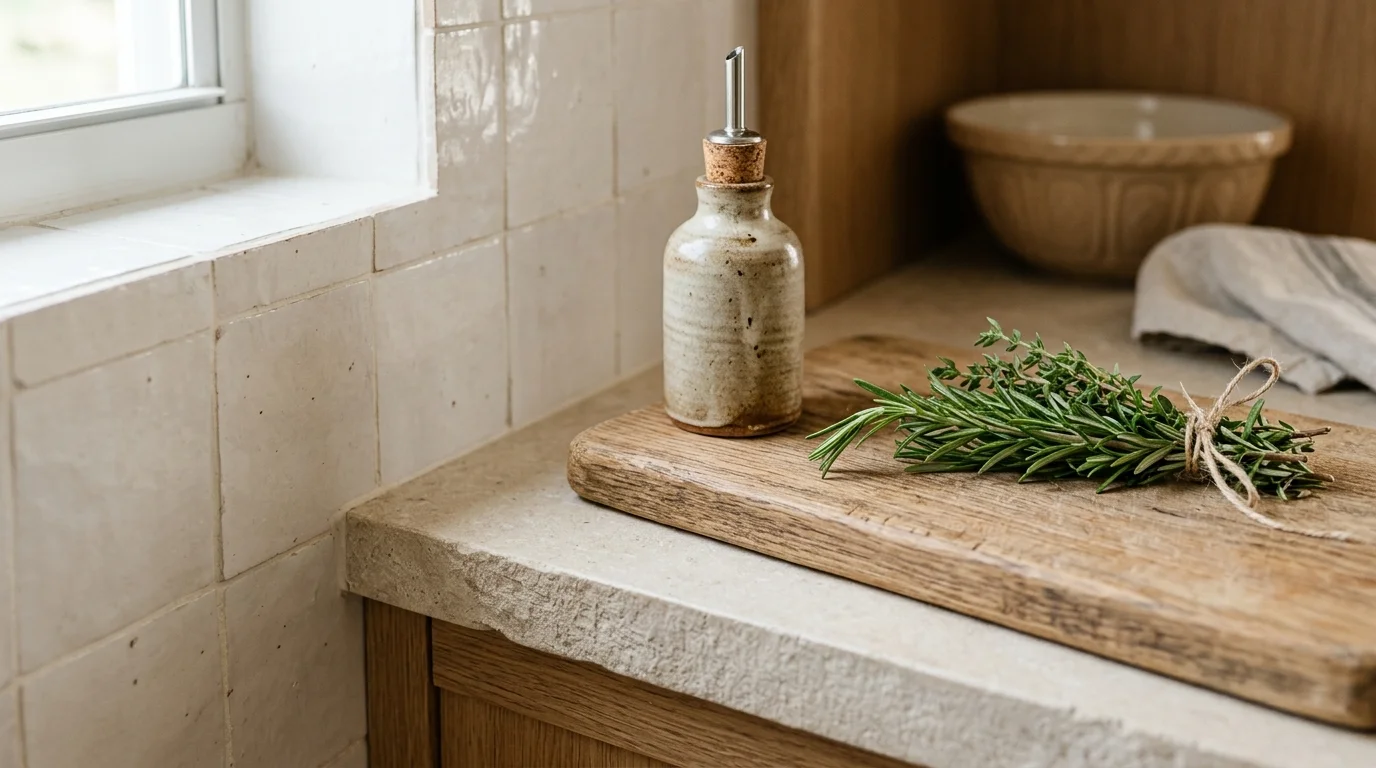
Hardware is the most direct expression of warmth in an otherwise restrained design. Brushed brass and unlacquered brass are the finishes we recommend most. They are warm, they complement wood tones, and they add just enough visual weight to cabinet faces without shouting. Brushed gold sits in a similar lane. Matte black works if the rest of the palette is on the warmer side, but it can tip the design cold if the stone and cabinets are already cool. Bar pulls and integrated finger pulls are the hardware profiles that suit this look best. Ornate knobs do not fit here.
Lighting is critical and often underbudgeted. In warm minimalist kitchens, the goal is layered, warm-toned light. Recessed lights should be 2700K to 3000K, not the 4000K daylight temperature that makes warm wood look greenish. Under-cabinet lighting is non-negotiable, especially on wood or stone slab backsplashes where the interplay of light and material is part of the design. Pendants over the island should have simple silhouettes, nothing with heavy ornamentation. A clean globe, a minimal cylinder, or a sculptural form in brass or matte black all work.
Appliances in this aesthetic benefit from integration. Panel-ready refrigerators and dishwashers that accept cabinet panels keep the wall of cabinetry uninterrupted. If a full panel-ready suite is outside the budget, stainless steel in a brushed or matte finish reads better than high-gloss chrome in this palette. Fingerprint-resistant stainless has gotten good enough that it no longer clashes with the warmth around it.
Sinks and faucets should stay simple. An undermount sink in white or stainless, a simple arc faucet in brushed brass or matte black. No farmhouse apron-front sinks here, that belongs to the farmhouse aesthetic, not warm minimalism. Integrated sinks in a stone or quartz material are another strong choice if the budget allows, since they eliminate the transition between counter and sink entirely.
Open shelving, used sparingly, adds the right kind of warmth. A single run of floating shelves in white oak on one wall, styled with a few ceramics and plants, adds life without clutter. We do not recommend converting all your upper cabinets to open shelving, the dust issue in South Florida alone makes that a poor long-term choice. But a focused open shelf moment is a design asset in this aesthetic. Appliance garages with flat-front doors that match the cabinet run help keep counters clear without hiding things in awkward pull-out locations.
Flooring ties the whole room together. Wide-plank wood-look tile or actual engineered wood in a warm tone is the right foundation. We lean toward tile in South Florida kitchens because of humidity and the occasional leak that comes with any home near the coast, but the material choice matters less than the color. Warm blonde, honey, or greige tones anchor the space. Dark espresso floors work against this aesthetic.
Cost Guide: Warm Minimalist Kitchen in Palm Beach County
What does a warm minimalist kitchen actually cost in Palm Beach County? The range is wide because the aesthetic can be executed at multiple price points. The wood tones and clean lines are achievable in a mid-range budget. The full custom version with rift-cut white oak, quartzite slab backsplash, and panel-ready appliances is a luxury spend. Here is how the numbers break down based on what we see in the market across Boca Raton, Delray Beach, Wellington, and Jupiter.
For full kitchen remodel cost context specific to your area, our Palm Beach County kitchen remodel cost guide covers the broader scope including labor, demo, and GC coordination. The table below focuses on the components most specific to the warm minimalist aesthetic.
Permit requirements depend on what your project touches. A cabinet swap, countertop replacement, and backsplash update on an existing layout typically does not require a permit in Palm Beach County. If your GC is relocating plumbing, running new gas lines, or modifying electrical service, those scopes will require permits pulled by your general contractor. Our Palm Beach County kitchen permit guide explains which scopes trigger permit requirements and what the process looks like.
South Florida Considerations for Warm Minimalist Kitchens
Designing a warm minimalist kitchen in Palm Beach County is not the same as designing one in the Northeast or Pacific Northwest. The climate, the light, and the building stock here all create conditions that affect material choices and design decisions in ways that matter.
Humidity is the first factor. South Florida's humidity swings, particularly during summer and hurricane season, can affect solid wood cabinetry if it is not properly sealed and the kitchen is not climate controlled. We prefer cabinet boxes built from moisture-resistant plywood or MDF with a durable finish over raw particleboard for any application here. The face frames and doors in natural wood are fine with the right finish, but the substrate matters. This is one reason we lean toward semi-custom and custom cabinets over builder-grade boxes in the South Florida market.
The UV index here is relentless. Finishes fade. Light-colored wood tones can shift if hit by direct western sun for years without window treatment or UV-filtering glass. When we design kitchens in Boca Raton and Delray Beach homes with large western-facing windows, we always flag this to homeowners. The fix is not to abandon wood tones, it is to plan for window treatments or specify UV-filtering glass when windows are part of a broader renovation scope.
HOA and ARB considerations are real for many homes in Wellington, Jupiter, and gated communities throughout Palm Beach County. If your renovation involves any exterior-visible changes, your general contractor will coordinate with your HOA's architectural review board. SFKB can supply design drawings and material samples to support that package, but the submission itself goes through your GC.
The warm minimalist aesthetic also performs exceptionally well in condo kitchens, which are common throughout the county. Many older condos in Boca Raton and Delray Beach carry dated 1980s or 1990s finishes that are the opposite of this look. A flat-front cabinet refresh with warm counters and a slab backsplash can transform those spaces completely. If you are working in a condo, your HOA will have specific rules about construction hours, elevator protection, and material delivery that your GC needs to coordinate. We work within those constraints regularly.
One final point: the warm minimalist kitchen is not a trend that will look dated in five years. It draws from design languages with deep roots, specifically Scandinavian and Japanese residential design, both of which have proven staying power. We have watched the all-white kitchen trend peak and fade. The warm minimalist direction feels more grounded than that. If you want to benchmark what this aesthetic is likely to do for your home's value, the data on kitchen remodel ROI in Palm Beach County gives you a realistic picture. And if you are still weighing whether a full remodel or a targeted refresh better fits your situation, our comparison of a kitchen refresh vs. full remodel breaks down when each approach makes sense. For anyone researching what natural wood cabinet options look like in a South Florida context specifically, our guide on natural wood kitchen cabinets in South Florida covers durability, finish options, and what to expect from the material over time.
Our team designs and installs warm minimalist kitchens throughout Palm Beach County, from Jupiter to Boca Raton. If you have a project in mind, reach out for a free estimate. We will give you an honest read on what the look costs at your scope and what decisions matter most.