Fluted Cabinets: Islands, Hoods and Vanity Ideas
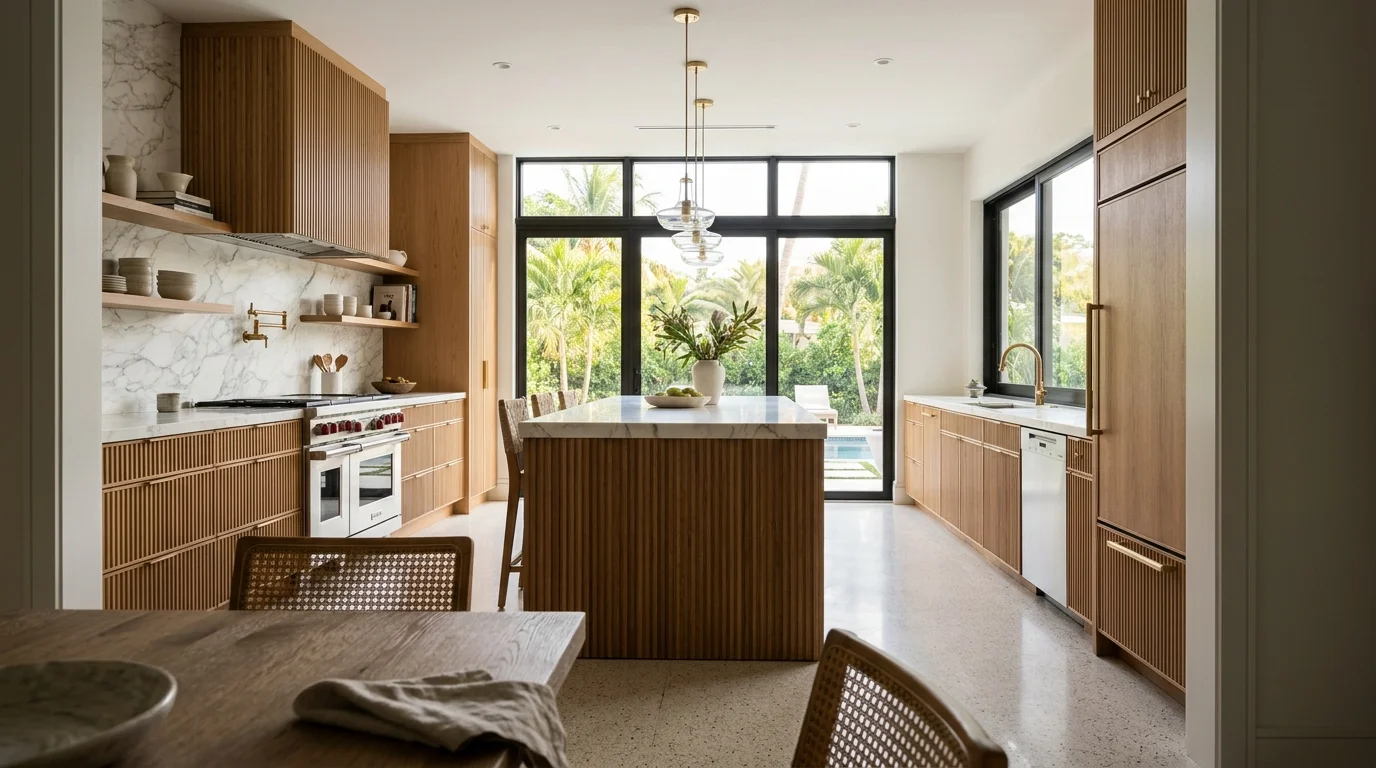
Fluted cabinets are one of the most talked-about design moves we see in Palm Beach County kitchens and bathrooms right now. The vertical grooves, technically called reeding or fluting, add depth and shadow to flat cabinet faces without screaming for attention. Done right, they read as architectural. Done wrong, they just look busy. We have installed fluted panels on kitchen islands in Boca Raton, range hood surrounds in Delray Beach, and floating vanities in Jupiter and Wellington, so we have a clear sense of where this detail works and where it does not. If you are thinking about adding fluted cabinets to your project, this guide covers the application, the material choices, and the real costs you should expect in the Palm Beach County market.
What Are Fluted Cabinets?
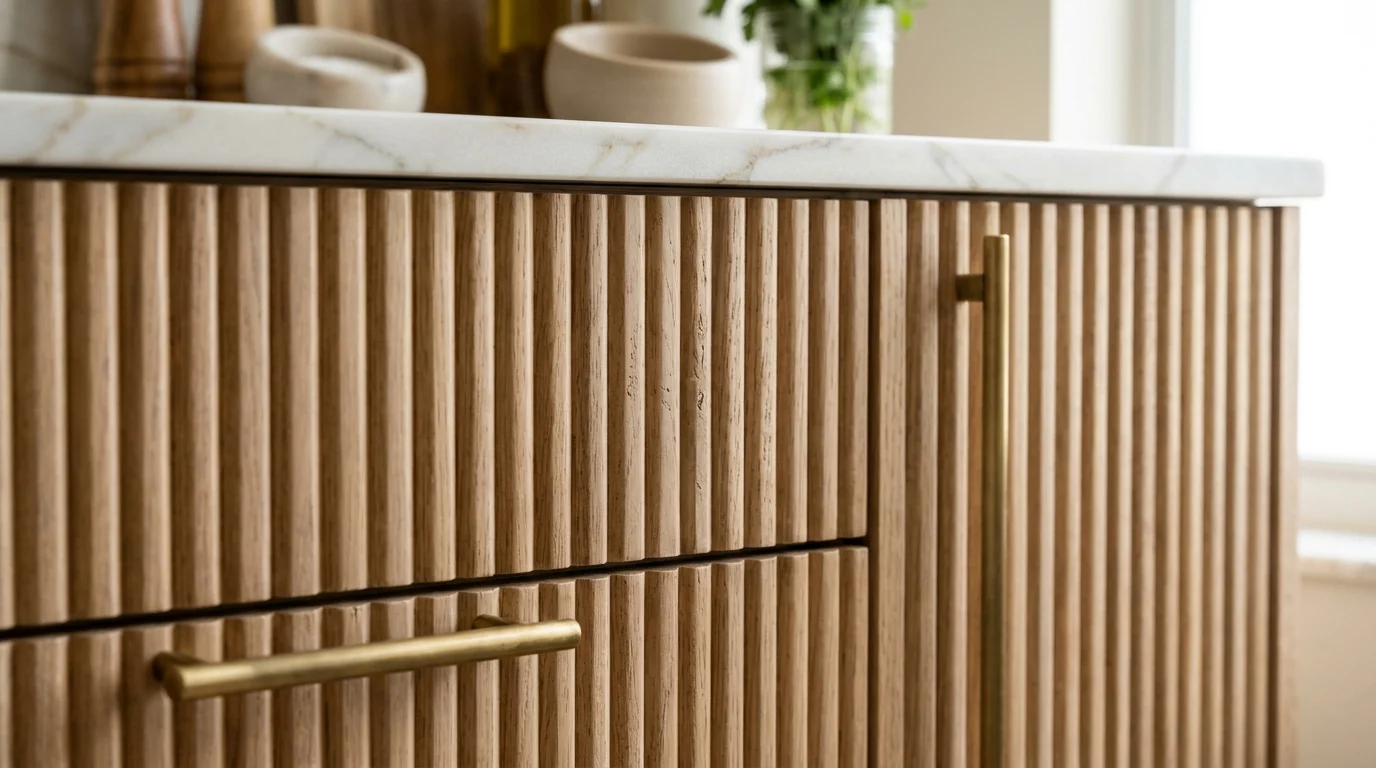
Fluting is a surface treatment, not a construction method. The term describes parallel vertical channels routed or molded into a flat panel. It is the same technique you see on classical columns and furniture from the Regency period. In cabinetry, the channels run vertically down door faces or exposed cabinet ends, creating a ribbed texture that plays with light and shadow across the surface.
Reeded panels are the inverse: raised ridges instead of recessed grooves. The two terms get used interchangeably in kitchen and bath design conversations, but they produce slightly different visual effects. Fluted panels look recessed and calm. Reeded panels look more pronounced and sculptural. For South Florida interiors, we lean toward fluted over reeded because the lighter look fits coastal and transitional styles better than the heavier reeded profile.
Fluting shows up in a few different ways on cabinetry:
- Applied fluted panels glued or fastened onto existing flat cabinet faces or end panels. This is the most common and cost-effective approach.
- Routed flat-front doors where the grooves are milled directly into the door. Cleaner, more durable, and what we recommend for new cabinet orders.
- Fluted glass inserts in upper cabinet doors, which we cover in depth over at our glass-front cabinet ideas guide.
Material matters here. Solid wood fluting holds detail beautifully and ages gracefully. MDF fluting is sharper at the edges right out of the shop but can chip at groove peaks over time, especially in humid South Florida environments. For painted finishes, high-quality MDF is fine. For stained natural wood looks, stick with real wood or a wood veneer over MDF core. You can read more about how those construction choices play out in our breakdown of MDF vs. plywood vs. solid wood cabinets.
One thing homeowners often miss: fluting on a cabinet door is a commitment to a specific hardware approach. Bar pulls and long integrated pulls work perfectly. Small round knobs sit awkwardly on a fluted face. Plan your hardware before you finalize the door style. Our guide on choosing kitchen cabinet hardware walks through the pairing logic in detail.
Fluted Islands and Range Hoods
The kitchen island is where fluted cabinets make the biggest visual statement. When the perimeter cabinets are flat-front or shaker style, a fluted island becomes a focal point without requiring a different color or material. The texture does the work. We see this combination constantly in Boca Raton and Palm Beach Gardens homes where the design goal is sophistication without maximalism.
A few things to know about fluted islands specifically:
Panel orientation matters. Fluted panels on the exposed ends of an island look intentional. Fluted panels on the base cabinet faces below the countertop overhang look designed. Trying to run fluting on the inside-facing cabinet doors that open toward the kitchen gets sloppy fast because the groove alignment rarely lines up perfectly at inside corners. Keep fluting on the exposed, visible surfaces.
Overhang seating and fluting work together. The shadow lines from the grooves draw the eye downward, which actually makes the island feel more grounded and substantial. If you have seating on one side, the fluted panel below the overhang gives guests something visually interesting to look at. It is a small detail that makes a real difference in person.
Color choices shift the vibe completely. Natural white oak fluted panels read warm and Scandinavian. A deep navy or hunter green fluted island reads British colonial or coastal club. A warm greige or putty reads transitional and timeless. We have done all of these in South Florida and each lands differently. If you are drawn to the wood tone direction, our article on white oak kitchen cabinets covers current finish options worth considering alongside fluting.
For more island planning guidance before you lock in a design, our kitchen island ideas for South Florida homes article covers sizing, seating, and layout in full.
Range hoods are the second place fluted panels shine. A hood surround with vertical fluting reads architectural, like something that belongs in a well-designed room rather than a purely functional kitchen. This works especially well on custom plaster hoods or painted wood surrounds because the fluting gives the flat surfaces a reason to exist. We tie this into our broader thinking on statement range hoods, where the finish treatment is often just as important as the hood shape itself.
A few practical notes on fluted hood surrounds: the fluting should run vertically on the flat faces of the hood box, not on angled or sloped surfaces. Angled fluting looks like a mistake. Keep it simple. The fluted panels on the hood should match or complement the fluted panels on the island if you are doing both. Using the same species and finish creates cohesion. Using slightly different tones for the hood versus the island can work as a subtle two-tone move, but it needs to be intentional.
Also worth noting: range hoods involve ventilation requirements that your general contractor and electrician need to handle before we install any hood surround. The design and fabrication of the cabinet surround is our scope; the duct work and electrical connections are not.
Fluted Vanity Ideas for Bathrooms
The bathroom is where fluted cabinets have arguably had their biggest moment over the past three years. A fluted vanity face in a primary bath or powder room signals intentional design in a way that plain shaker doors no longer do. It is a small change with a big return on visual investment.
We install fluted vanities across Palm Beach County, from smaller powder rooms in Wellington townhomes to full primary baths in custom homes near Jupiter Inlet. The scale of the fluting should match the scale of the vanity. Fine, tight fluting on a 36-inch single vanity looks refined. The same tight pattern blown up on a 72-inch double vanity can look over-engineered. For large vanities, we prefer a slightly wider channel spacing so the rhythm of the grooves reads naturally at a larger scale.
Floating vanities and fluted panels are a natural pairing. The clean gap below a floating vanity and the vertical grooves above it both point in the same direction: upward, light, modern. If you are considering this combination, our guide on floating vanity bathroom ideas gives you the full picture on mounting requirements and typical heights.
For powder rooms specifically, a fluted vanity paired with an oversized mirror and a statement light fixture is one of our favorite high-impact combinations. The powder room is the one space in the house where guests spend just enough time to notice every detail. Spending a bit more on a fluted vanity face in a 40-square-foot powder room makes more sense per square foot than almost any other investment in the house. Our powder room design ideas for Palm Beach County article covers this in depth.
Hardware pairing on fluted vanities follows the same logic as kitchens. Brushed brass bar pulls are our top recommendation because the warm metal picks up and softens the strong vertical lines. Matte black pulls also work well for a more graphic contrast. What we steer clients away from: round knobs. They interrupt the groove pattern visually and look like an afterthought. If you want to understand the full logic of finish selection, our piece on brass cabinet hardware walks through why that finish is leading the market right now.
One underrated application: fluted panels on the side of a freestanding vanity that sits against an open wall. When you walk into the room, you see the end panel before you see the front. A fluted end panel on a vanity in that position is the first thing your eye catches. It is a small detail that elevates the whole room without touching the countertop or the tile.
Cost Guide
Fluted cabinet costs in Palm Beach County depend on whether you are adding fluted panels to existing cabinets, ordering new doors in a fluted style, or doing a full cabinet package with fluting as the design specification. Here is what you should expect to pay in the current market:
Applied fluted panels are the budget-friendly entry point. If your island is in good shape but the faces are plain, we can apply pre-made fluted MDF or wood panels to the exposed ends and base faces for a few hundred dollars in material. Labor to fit, finish, and install them properly runs the total to roughly $400-$900 depending on how many panels are involved and whether the finish needs to be painted on-site to match.
Ordering new fluted doors to replace existing flat-front or shaker doors is a mid-range investment. The cost depends on door count, material, and finish. Painted MDF doors in a fluted profile from a quality semi-custom line come in at the lower end of the range. Solid wood or veneer in a custom stain color sits at the top. If you want to understand how that custom-to-semi-custom spectrum works in terms of pricing, our guide on semi-custom vs. custom cabinets explains the trade-offs clearly.
A full kitchen with a fluted island as the design centerpiece and flat-front or shaker perimeter cabinets runs $28,000-$65,000 at the mid-range to upper-mid level. That includes cabinetry, countertops, backsplash tile, and finish carpentry. It does not include appliances, plumbing fixtures, or electrical work, which are outside our scope and handled through your GC. For a broader view of what a complete kitchen costs in this market, our kitchen remodel cost guide for Palm Beach County breaks down every cost category.
According to NAHB remodeling market data, kitchen and bath remodeling demand has remained strong in markets like South Florida where home values and design expectations continue to climb. That means material lead times and labor costs have not softened much, so the ranges above reflect current market reality, not national averages.
South Florida Considerations
South Florida's humidity is the variable that changes almost every material decision we make. Fluted cabinets are no exception. The channels in a fluted panel create more surface area than a flat door, which means more opportunity for moisture to settle and sit if the finish is not right. Here is what that means practically:
Paint finish matters more than usual. A high-quality conversion varnish or catalyzed lacquer is what we specify on painted fluted cabinets in Palm Beach County. Standard latex or alkyd paint is not built for the humidity swings between air-conditioned interiors and open windows during mild weather. The conversion varnish cures harder and resists humidity-driven expansion better. This is especially important in bathrooms, where steam from showers cycles daily.
Wood species choice for stained fluting. Rift-cut white oak is our top recommendation for stained fluted cabinets in South Florida. The tight, straight grain of rift-cut oak holds the fluting detail cleanly and does not move as much as plain-sawn wood under humidity changes. Quarter-sawn maple is a close second. Walnut is beautiful but more expensive and can darken unevenly in strong sunlight near windows, which is relevant in Jupiter and Delray Beach homes with east or south-facing kitchens that get serious morning sun.
Bathroom applications need more attention. A fluted vanity in a primary bath that sees daily hot showers needs to be sealed properly and the bathroom needs adequate ventilation. If your exhaust fan is undersized, moisture will find the grooves in those panels over time. Our bathroom exhaust fan CFM guide covers how to size your fan correctly for the room. It is an easy fix and it protects your investment.
HOA and ARB design review. If you live in a gated community in Wellington, Palm Beach Gardens, or the barrier island towns, your Architectural Review Board may have opinions about exterior-facing design changes. Interior remodels rarely trigger ARB review, but if your project includes opening walls, adding windows, or changing any exterior element, your GC will need to coordinate with the HOA and may need to supply design drawings. We provide the design package and material samples for that process; your GC submits it to the ARB.
Permits for cabinet work. Swapping cabinet doors to fluted styles, adding a new vanity to an existing rough-in, or reskinning an island with fluted panels typically does not require a building permit. Permits become necessary when the project involves moving plumbing, changing electrical service capacity, or opening structural walls. If your GC is relocating your sink or adding new circuits for the hood, those scopes will require permits through Palm Beach County's building department. For a full breakdown of when permits apply to kitchen work, see our kitchen remodel permit guide for Palm Beach County.
Lead times in this market. Custom and semi-custom cabinet orders with fluted door profiles are running 8-14 weeks from most manufacturers right now. If you want a specific natural wood species or a bespoke channel width, add another 3-4 weeks. Plan around that. We tell clients in Boca Raton and Delray Beach to treat the cabinet order date as the fixed point in the project timeline and work backward from there. Everything else can flex; the cabinet lead time mostly cannot.