Japandi Kitchen Design: 2026 Guide
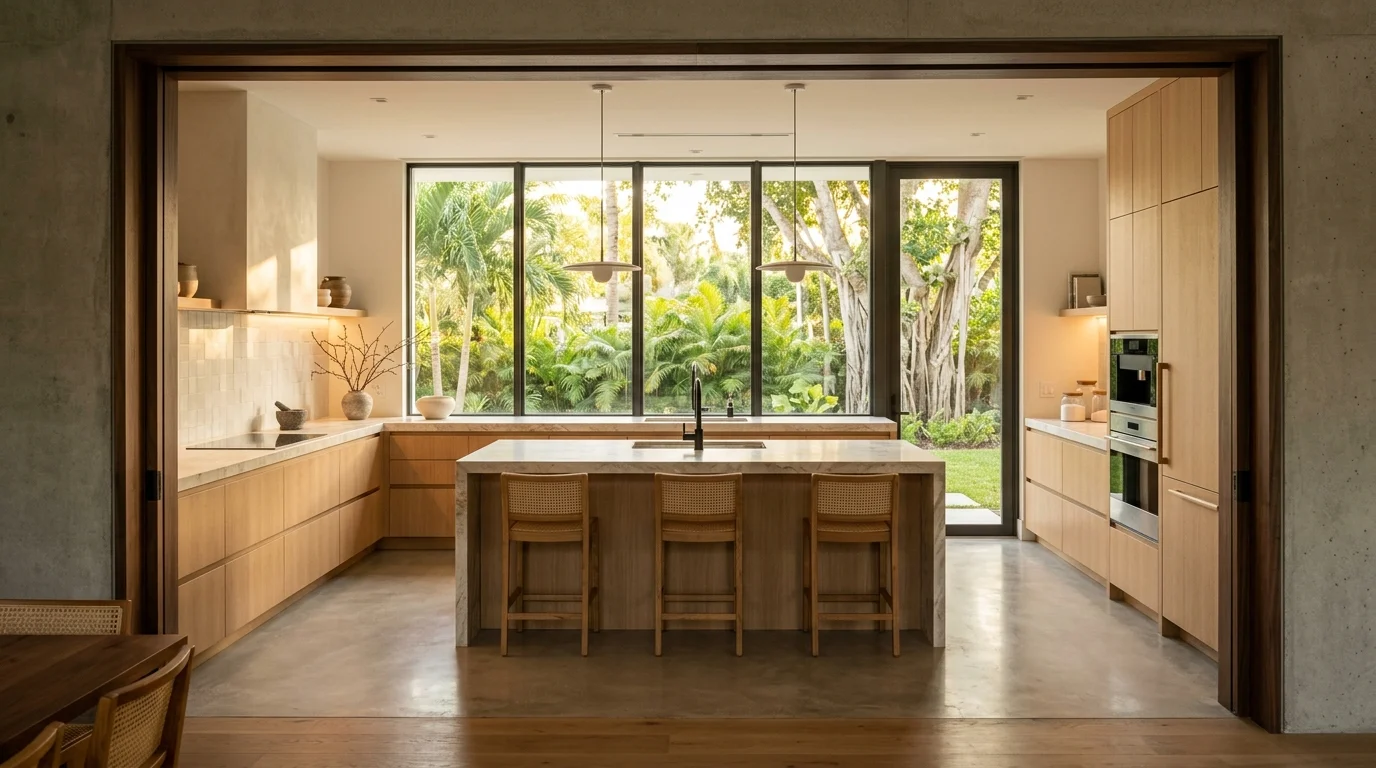
The Japandi kitchen is the design world's answer to the question most South Florida homeowners are quietly asking: how do we get away from the sterile all-white kitchen without going full rustic farmhouse? The answer is a blend of Japanese minimalism and Scandinavian warmth, warm wood tones, muted earth colors, handcrafted materials, and an almost obsessive commitment to clean lines and negative space. If you're remodeling in Palm Beach County, Boca Raton, Delray Beach, Wellington, or Jupiter, this aesthetic translates remarkably well to the natural light and open layouts common in our market.
We've been seeing Japandi requests climb fast in our design consultations over the past two years. It's not a fad. It has real staying power because it doesn't rely on trendy colors that age badly or complicated ornamentation that's expensive to replace. It ages gracefully, which matters when you're investing $25,000 or more into a kitchen remodel.
What Is Japandi Kitchen Design?
Japandi is a portmanteau of Japanese and Scandinavian design philosophies. Japanese design, rooted in the concepts of wabi-sabi (finding beauty in imperfection) and ma (intentional empty space), prioritizes natural materials, restraint, and function. Scandinavian design shares the minimalist DNA but adds coziness (the Danish concept of hygge), lighter wood tones, and a practical approach to everyday living. Together, they produce a kitchen aesthetic that feels calm, considered, and lived-in without looking cluttered.
In practical terms, a Japandi kitchen has flat-front or very slim-profile cabinetry, warm wood or wood-look finishes, a neutral palette anchored by off-whites, warm grays, warm beiges, and deep earth tones, and hardware that almost disappears into the design. Every element earns its place. There's no decorative corbel, no ornate crown, no busy backsplash tile competing with the cabinetry. The kitchen breathes.
This is a real departure from the traditional South Florida kitchen, think the heavy raised-panel cabinetry and granite-over-everything look that was everywhere from 2000-2015. Homeowners in gated communities from Palm Beach Gardens to Wellington are actively looking to update those kitchens, and Japandi gives them a direction that feels both current and timeless. If you want to understand how cabinet door style drives the entire room's direction, our breakdown of flat-front vs. shaker cabinets in South Florida is worth reading before you commit to either path.
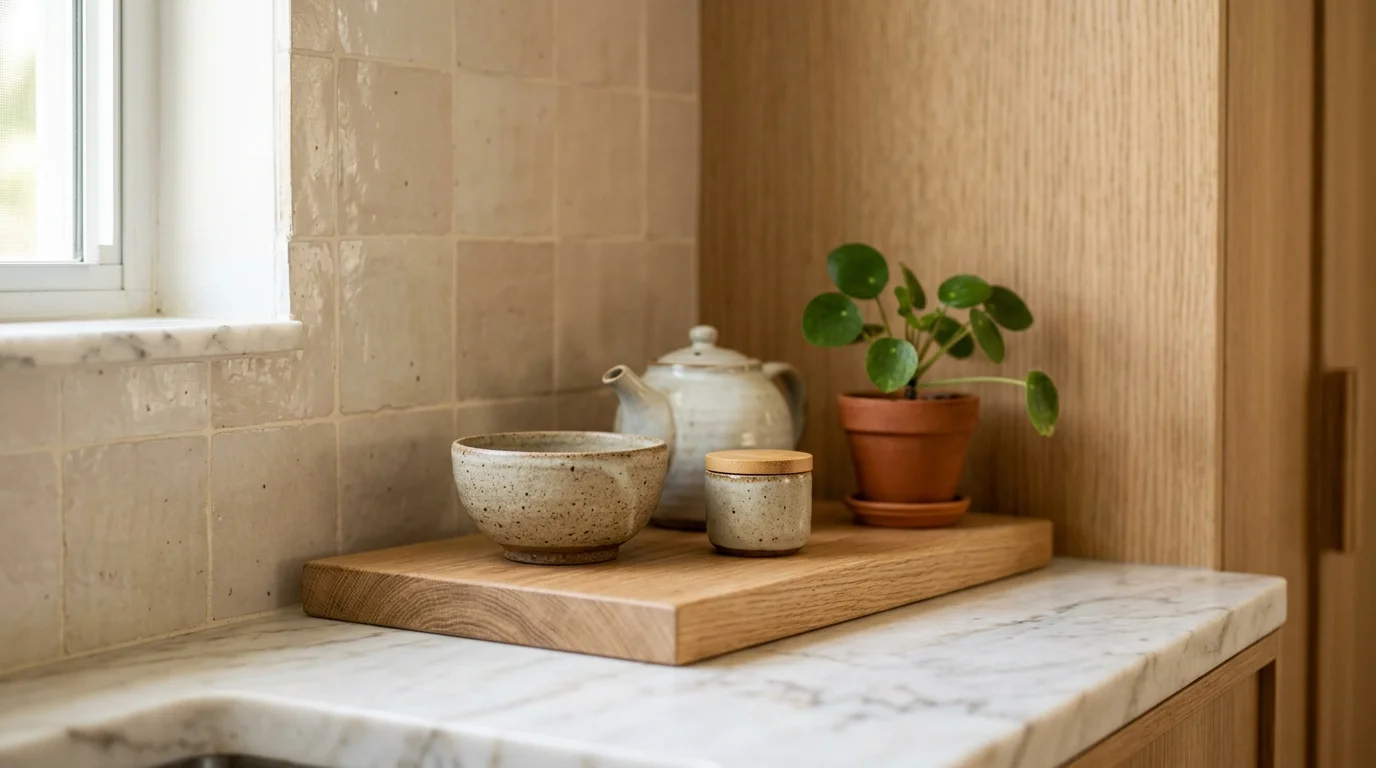
One thing we want to be clear about: Japandi is not cold. That's the most common misconception. The warmth comes from the materials, oiled oak, white ash, walnut, linen textures, handmade ceramics. The restraint in color and ornament makes those warm materials stand out even more. Done right, a Japandi kitchen feels like the most comfortable room in the house.
Materials & Finishes That Define the Look
Material selection is where a Japandi kitchen either lands or falls apart. You can have perfectly flat-front cabinets and then choose the wrong countertop or backsplash and lose the whole vibe. Here's how we think about each surface.
Wood tones: The anchor of the look. White oak is the most popular choice right now, it has enough warmth to feel inviting and enough neutrality to work with almost any wall color. Rift-sawn white oak in particular shows tight, straight grain lines that feel very Japanese in their precision. Walnut reads richer and moodier, which works well for lower cabinets in a two-tone setup. Avoid highly figured, busy grain patterns, the wood should be calm, not the star of the show. Our team routinely uses wood-look thermofoil and textured laminate for clients who want the look without the cost or humidity concerns of real wood; in South Florida's climate, that's often the smarter call. For a deeper look at how natural wood species hold up here, read our guide on natural wood kitchen cabinets in South Florida.
Countertops: Honed or leathered finishes over polished. A honed quartz or quartzite in a warm white, soft gray, or warm beige is the classic Japandi move. Polished counters reflect too much light and read as flashy, the opposite of the philosophy. Porcelain slabs in a concrete or stone look are also a strong option; they're extremely durable and work well in our heat and humidity. We stay away from busy veining for Japandi kitchens. A tight, subtle movement or an almost solid-surface look is closer to the mark. If you're weighing material options, our article on porcelain vs. quartz countertops walks through the real-world trade-offs.
Backsplash: Keep it quiet. Large-format subway in a warm white or off-white, zellige-inspired handmade tiles in earthy tones, or a slab backsplash that extends the countertop material up the wall. The slab-to-backsplash continuity is particularly strong in Japandi kitchens because it eliminates visual noise entirely. If you're on the fence about how much of the wall to tile, our comparison of 4-inch vs. full-height backsplash options covers the pros and cons clearly.
Flooring: Wide-plank wood or wood-look tile. The grain should run in one direction, parallel to the longest wall, ideally, to reinforce the horizontal calm of the design. Herringbone and other pattern-heavy layouts work against the Japandi feel. If you're open to tile that mimics wood, large-format porcelain planks (12x48 or similar) in a warm oak or ash color are an excellent choice for South Florida because they handle moisture and heavy traffic without warping. See our full breakdown of kitchen flooring options and their pros and cons for more detail.
Color palette: Warm whites, warm beiges, sage, warm charcoal, terracotta as an accent. No cool grays, no icy blues, no stark white. If you're choosing cabinet paint, a warm white like Benjamin Moore White Dove or Sherwin-Williams Alabaster is closer to the mark than a crisp, bright white. Deep muted greens, sage, moss, forest, are having a major moment in Japandi kitchens and work exceptionally well in South Florida's light. Our overview of kitchen color trends for 2026 has more on the warm neutral direction the market is moving.
Cabinet & Hardware Choices
The cabinetry is doing most of the heavy lifting in a Japandi kitchen. Get this right and everything else falls into place. Get it wrong and no amount of beautiful countertop will save the room.
Flat-front (slab) doors are the default Japandi cabinet choice. They read clean, minimal, and modern, all three things you want. Some designers use a very slim shaker profile with a tight reveal, which softens the look slightly without adding the decorative weight of a traditional shaker. We generally recommend full flat-front for a true Japandi kitchen, but slim shaker is a legitimate middle path if clients want something a bit warmer. The slim shaker cabinet trend for 2026 is worth understanding before you choose between the two.
Frameless construction is the better fit for Japandi because it maximizes interior storage and eliminates the face frame that adds visual weight to the cabinet box. That said, a well-built framed cabinet with a full-overlay flat door still reads cleanly. The choice between frameless and framed comes down to budget and personal preference, the NKBA has published standards on both construction types if you want to go deep on the technical differences.
Hardware is where people often overthink it. Japandi hardware is minimal, integrated finger pulls routed directly into the door, thin bar pulls in matte black or brushed bronze, or no hardware at all with push-to-open mechanisms. Matte black is the most popular finish in our current projects. It has enough visual weight to register against a warm wood cabinet without being decorative. Brushed gold works in Japandi kitchens when the rest of the palette is warm enough to carry it. Polished chrome or nickel is too cold for this aesthetic. Our full kitchen cabinet hardware guide for Palm Beach County goes into finish pairings in detail.
Two-tone cabinet layouts, warm wood lowers with a muted upper color, or vice versa, are very Japandi when done with restraint. The key is keeping the upper cabinet color in the same muted, earthy family as the rest of the palette. Stark contrast doesn't fit the philosophy. A warm charcoal lower cabinet paired with a creamy white upper cabinet is a perfect example. Walnut lower + off-white upper is another strong combination we see regularly in Jupiter and Boca Raton kitchens.
Panel-ready appliances are the gold standard for Japandi kitchens, they allow the refrigerator and dishwasher to disappear into the cabinetry. They carry a premium, but the visual impact is significant. If your budget doesn't support panel-ready appliances, stainless steel is fine as long as you choose a brushed or matte finish over a mirror-polished one. Integrated sinks, undermount or flush-mounted, fit the aesthetic well; the countertop surface reading uninterrupted matters in a design that values calm horizontal lines.
Cost Guide
What does a Japandi kitchen actually cost in Palm Beach County? The answer depends heavily on scope and material choices. The aesthetic can work at multiple budget levels, it's more about discipline in selection than spending the most money. That said, the flat-front cabinet style, honed stone countertops, and minimal hardware that define the look do tend to pull toward the mid and upper ranges when you're using quality materials.
Here's how we break it down for Palm Beach County, Boca Raton, Delray Beach, Wellington, and Jupiter projects:
Keep in mind that permits depend entirely on your project scope. If you're swapping cabinets and countertops on an existing layout without moving plumbing, electrical, or walls, a permit is typically not required. If your Japandi remodel involves relocating the sink, adding an island with new plumbing, or changing your electrical panel capacity, your general contractor will need to pull the appropriate permits through Palm Beach County's Building Division. That's your GC's scope, SFKB handles the design, cabinetry, countertops, tile, and finish carpentry side of the project.
For a full breakdown of what kitchens cost at different scope levels in our market, our kitchen remodel cost guide for Palm Beach County has current numbers.
South Florida Considerations
Japandi design was born in cooler climates, Japan and Scandinavia both have a very different relationship with humidity, sunlight, and heat than we do in South Florida. Translating the aesthetic to Palm Beach County requires a few practical adjustments.
Humidity is the biggest factor. Real wood cabinets and wood countertops (butcher block) can expand, contract, and warp in our climate if not properly sealed and maintained. Our team has seen beautiful rift-sawn oak cabinet doors develop telegraphing and minor warping in kitchens where the HVAC wasn't running consistently, think seasonal residents who shut the house down for months. For those clients, high-quality wood-look thermofoil or textured laminate is a smarter choice. It reads nearly identical visually, especially in flat-front applications, and it won't move with the humidity. If you're set on real wood, the species and finish matter, ask about moisture-resistant finishing options specifically rated for South Florida conditions.
Natural light is a major asset in South Florida that plays directly into the Japandi aesthetic. Our homes, particularly in Boca Raton, Delray Beach, and Wellington, tend to get significant natural light throughout the day. Japandi's warm neutrals and natural materials look extraordinary in that light. The wood tones glow. The honed stone countertops develop a beautiful patina in sunlight without the glare of a polished surface. If you're planning under-cabinet or pendant lighting, warm-toned LED (2700K, 3000K) complements the palette far better than cooler daylight-tone bulbs.
HOA and community architectural review is a real consideration in many Palm Beach County communities. If you're in a gated community in Wellington, a condo in Boca Raton, or a planned development in Jupiter, your HOA may have guidelines on exterior-visible changes. Interior kitchen remodels are generally outside HOA scope, but if your renovation involves any exterior impact, new windows, exterior wall work, your GC will need to navigate the approval process. SFKB supplies design drawings and material samples to support that process; your GC submits the package to the appropriate board.
Material sourcing for Japandi kitchens is increasingly strong in our market. The move toward warm neutrals and natural stone looks in 2025-2026 has brought more Japandi-compatible countertop slabs and cabinet finishes to local suppliers. If you want to see slabs in person before committing, which we always recommend for honed stone, our guide to the best places to buy countertop slabs in Palm Beach County covers your options.
One more thing worth saying: Japandi kitchens photograph beautifully, and that matters for resale. The warm, calm aesthetic appeals to a wide demographic, it doesn't read as too trendy or too personal. In the Jupiter and Palm Beach Gardens luxury market especially, a well-executed Japandi kitchen is a strong value add. The minimalism signals quality and intention in a way that busy, heavily decorated kitchens often don't. If you're thinking about the ROI angle, our article on which kitchen upgrades add the most value to a Florida home puts the numbers in perspective.