Kitchen Cabinet Door Styles: Complete Guide
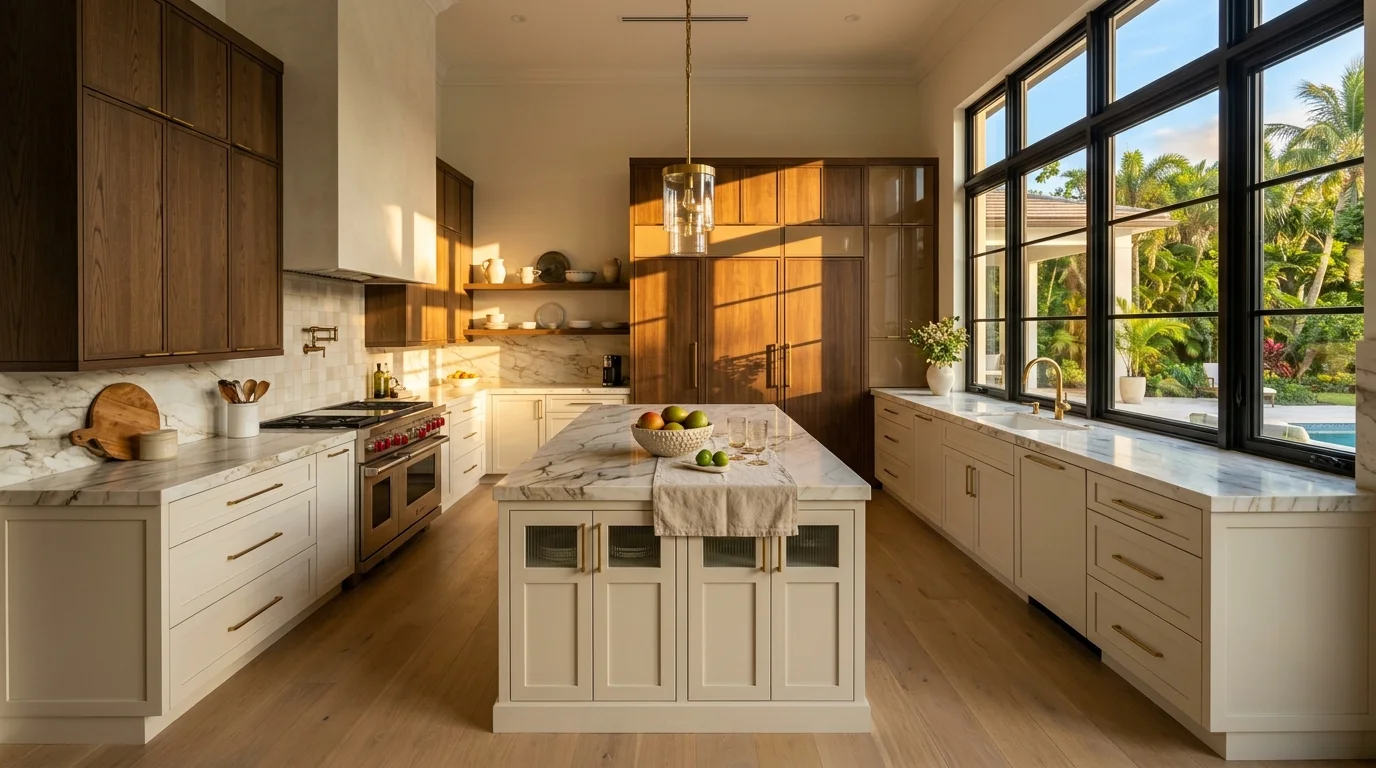
Choosing kitchen cabinet door styles is the single most visible design decision in any kitchen remodel. The door is what you see every day. It sets the tone for the whole room before the countertop, the hardware, or the backsplash gets a vote. In Palm Beach County kitchens, from Wellington ranch homes to Boca Raton waterfront estates, we see homeowners agonize over countertop colors for weeks, then spend fifteen minutes picking a door style. That order should be reversed. Get the door style right first, and the rest of the room falls into place around it.
This guide covers every major style category: shaker, slim shaker, flat-front, raised panel, and the specialty profiles in between. We also break down the inset versus overlay decision, which is a structural and budget question that most homeowners don't know to ask. By the end, you'll have a clear opinion about what works for your home, your budget, and the South Florida aesthetic.
Why Door Style Is the Most Visible Decision You'll Make
Cabinet boxes, whether framed or frameless, are largely invisible once the doors are hung. The door is the face of the cabinet. It determines whether your kitchen reads as modern, traditional, coastal, transitional, or somewhere in between. It also affects how easy the kitchen is to clean, how the hardware sits, how the paint or stain reads, and how the whole room photographs.
We've remodeled kitchens across Delray Beach, Jupiter, and North Palm Beach where homeowners chose a door style that clashed with their ceiling height, their hardware choice, or their countertop profile. The result was a kitchen that looked busy, dated, or just slightly off. No one element was wrong in isolation, but the combination didn't work. Door style is the anchor. Everything else coordinates to it.
There's also a resale argument. According to Remodeling Magazine's Cost vs. Value data, kitchen remodels consistently return strong value in South Florida's market. But that return depends on the kitchen looking current. A raised-panel door with heavy ornamental detail that might have been premium in 2005 can actively hurt your resale price today if it reads as dated to buyers in Boca Raton and Palm Beach Gardens. Door style ages. Choose one with staying power.
One more thing worth saying plainly: door style and cabinet construction are related but separate decisions. A slim shaker door can be built on a framed or frameless box, in plywood or MDF, painted or stained. If you want to understand the box construction side of this, our guide on frameless vs. framed cabinets covers that in detail.
Shaker and Slim Shaker Cabinets
Shaker is the dominant cabinet door style in South Florida right now, and that's not going to change anytime soon. A classic shaker door has a five-piece construction: four rails and stiles forming a flat recessed center panel. The profile is clean. It works with painted finishes, stained wood, and two-tone combinations. It pairs with traditional hardware, modern bar pulls, and everything in between. There's a reason it's been the best-selling style in our showroom for years.
The proportions matter more than most homeowners realize. Standard shaker has rails and stiles that are typically 2.25 to 2.5 inches wide. That width reads as solid and traditional, which is fine for farmhouse kitchens, transitional designs, and older homes. But in a modern or contemporary space, those wider frames can make the kitchen feel heavier than intended. That's where slim shaker comes in.
Slim shaker, sometimes called thin shaker or narrow-rail shaker, uses rails and stiles that are typically 1.25 to 1.75 inches wide. The center panel is larger relative to the frame. The overall effect is lighter, more refined, and distinctly more modern. We've seen slim shaker take over in coastal contemporary kitchens in Jupiter and North Palm Beach, and it's showing up in new construction across Wellington. If you're planning a modern or Japandi-inspired kitchen, slim shaker is almost always our recommendation over a flat-front door, because it gives you some visual texture without the hard-line minimalism that can make a kitchen feel cold.
Our full breakdown on slim shaker cabinets goes deeper on rail widths, finish options, and how the profile photographs in South Florida light. Worth reading before you finalize any order.
For white shaker specifically, which is still the most popular single finish we sell, the choice of paint sheen and primer quality matters enormously in Florida's humidity. We're opinionated about this: we recommend a high-quality factory-applied conversion varnish over a field-painted door every time. The durability gap is real. More on that in our guide to the best paint for kitchen cabinets in Palm Beach County.
Flat-Front, Raised Panel, and Specialty Styles
Beyond shaker, the two most common door styles we work with are flat-front and raised panel. They sit at opposite ends of the visual spectrum, and both have legitimate applications in South Florida homes.
Flat-front (slab) doors have no frame, no profile, and no center panel recess. The door face is a single flat surface. Done well, flat-front cabinets look sleek, minimal, and expensive. Done poorly, they can look cheap or unfinished. The difference usually comes down to material quality, edge detail, and hardware. A flat-front door in a matte lacquer finish with integrated pulls or thick bar handles looks intentionally modern. The same door in a thin thermofoil with builder-grade knobs looks like a rental unit.
Flat-front cabinets are the right call for true contemporary and minimalist kitchens. They're also popular in European-style frameless configurations. The tradeoff is that every smudge, hinge mark, and fingerprint shows more obviously than on a shaker door, because there's no shadow line or profile to draw the eye away from surface marks. In a busy South Florida family kitchen, that matters. We generally recommend flat-front to homeowners who cook less frequently or who prioritize aesthetic over daily practicality. For everyone else, shaker or slim shaker gives more forgiveness.
Our detailed comparison at flat-front vs. shaker cabinets for South Florida walks through side-by-side scenarios if you're genuinely torn between the two.
Raised-panel doors have a center panel that's routed or shaped to sit above the plane of the surrounding frame. Classic raised panel has an arch or cathedral top on the center panel, which is the most traditional look. Square raised panel drops the arch and uses flat geometry, which reads more transitionally. Raised panel dominated kitchen design from the 1980s through the mid-2000s. It's associated with formal, traditional, and colonial architecture.
We still sell raised-panel doors, and we still recommend them for the right homes. A Mediterranean-style estate in Palm Beach Gardens or a traditional colonial in Jupiter may look completely wrong with shaker. The raised panel fits the architecture. But if your home is a modern CBS construction in Boca Raton or a coastal cottage in Delray Beach, raised panel is almost certainly going to feel dated before you're ready to remodel again. Be honest about your home's style before committing.
Beadboard doors use vertical grooves on the center panel to evoke a traditional cottage or farmhouse look. They show up frequently in coastal and beach-style kitchens. They're harder to clean than any other style because the grooves trap grease and dust, and South Florida's cooking environment makes that a real maintenance issue. We recommend beadboard only on islands or pantry sections where the cleaning burden is lower.
Glass-front doors aren't a separate door style so much as a variation on any of the above. Shaker frames with glass inserts are common for upper cabinets. They add depth, display value, and light. The tradeoff is that everything behind the glass needs to look organized. If your dishes are mismatched and your shelves are cluttered, glass-front cabinets will advertise that to every guest in your kitchen. Our glass-front cabinet ideas guide covers insert types and placement strategies.
Inset vs Overlay: The Framing Decision Behind the Door
This is the section most homeowners skip, and it's one of the most important decisions in the whole cabinet order. Inset versus overlay isn't about the door profile itself. It's about how the door sits relative to the cabinet face frame.
Overlay doors sit in front of the face frame and overlap it. Full overlay covers almost the entire face frame, leaving only a small reveal between doors and drawer fronts. Partial overlay (standard overlay) leaves more of the face frame exposed. Full overlay is what most modern and semi-custom cabinets use today. It's cleaner, it's more affordable to build, and it's what the majority of our projects specify.
Inset doors sit flush inside the face frame opening, like a door inside a door frame. The hinges are typically visible on the exterior, and the fit has to be extremely precise. Inset cabinets have a furniture-quality look that's distinctly higher-end. They're associated with traditional craftsman design and custom cabinetry. The tradeoff is cost (significantly higher), lead time (longer), and sensitivity to humidity. In South Florida, where seasonal humidity swings are real, wood inset doors can expand and contract enough to affect the fit. A well-built inset cabinet from a quality manufacturer handles this fine, but it's a real consideration.
We recommend inset for homeowners doing a full custom project with a higher budget who specifically want that flush, furniture-grade look. For most mid-range projects in Palm Beach County, full overlay shaker or slim shaker gives you 90% of the visual quality at a fraction of the cost. Our detailed comparison at inset vs. overlay cabinets covers the cost and construction differences thoroughly.
One related decision worth mentioning: the door style you choose affects how hardware sits and how it needs to be placed. A shaker door has a natural centering point for pulls and knobs. A flat-front slab has more flexibility but also more room for placement errors. Our cabinet hardware placement guide addresses this for every major door style.
Cost Guide
Door style has a direct impact on cabinet pricing. Here's what our Palm Beach County projects typically look like across style and quality tiers. These figures cover cabinet supply and installation only. Countertops, appliances, plumbing fixtures, and electrical work are separate line items handled by your GC or the respective trades.
Door style alone won't make or break your budget, but it's a multiplier. A raised-panel door in solid cherry custom built is a very different price point than a flat-front door in painted MDF, even if both are technically "custom." If you're trying to understand what your total project budget should look like, our kitchen remodel cost guide for Palm Beach County breaks the full picture down by scope.
Cabinet refacing is worth mentioning here for homeowners who like their current box layout but want a different door style. Replacing doors and drawer fronts, adding new veneer to the boxes, and updating hardware can change the entire look of a kitchen for significantly less than a full replacement. Our cabinet refacing cost guide covers what that scope looks like in Palm Beach County pricing.
South Florida Considerations
Cabinet door style decisions in South Florida come with some environment-specific factors that homeowners in other parts of the country don't have to think about as much. Here's what matters in our market.
Humidity and wood movement. Solid wood doors expand and contract with humidity changes. In South Florida, where we cycle between dry season and rainy season, that movement is real. Painted MDF doors are more dimensionally stable than solid wood in high-humidity environments, which is one reason painted shaker in MDF is so dominant here. If you want a stained wood look, make sure you're working with a manufacturer who engineers their doors specifically for humidity tolerance. A poorly constructed solid wood door in Delray Beach will warp within a few years. Our guide on how to fix a warped cabinet door explains why this happens and what can be done, but prevention beats repair every time.
Coastal salt air. Homes within a mile of the coast in Boca Raton, Jupiter, or Juno Beach see accelerated finish degradation on hardware and cabinet exteriors. This doesn't change the door style choice, but it does affect finish selection. Factory-applied conversion varnish over field-painted doors, and coated or solid brass hardware over chrome or nickel, hold up significantly better in salt-air environments.
HOA and architectural review. Gated communities and historic neighborhoods in Palm Beach County sometimes have architectural guidelines that affect cabinet visibility from exterior-facing windows. If your kitchen faces a front courtyard or a community common area, check your HOA documents before committing to a high-contrast two-tone cabinet scheme. This isn't a common issue, but it does come up in communities in Wellington and some older neighborhoods in Delray Beach.
Style and resale. South Florida's buyer pool skews toward clean, modern, and coastal aesthetics. Heavy ornamental raised panel, cathedral arches, and rope-detail doors tend to turn off buyers in our market even when the underlying construction is excellent. If resale is a factor in your decision timeline, shaker and slim shaker are the safest bets for broad appeal. NAHB remodeling data consistently shows that kitchens are the highest-impact room for resale, and door style is one of the first things buyers notice.
Current trends in our showroom. What's actually moving in Palm Beach County right now: slim shaker in warm whites and warm greiges, natural wood tones in rift-cut white oak and cerused finishes, and two-tone combinations pairing a painted upper with a wood-tone lower. Flat-front in matte finishes is strong in contemporary new construction. Raised panel is still selling, but almost exclusively in traditional estate homes. If you want to go deeper on the trend picture, our kitchen cabinet trends for 2026 covers what's gaining and what's fading in the local market.